How to Budget for Precision Agriculture
Learn how to build a precision farming budget, estimate precision agriculture cost per hectare, calculate ROI, and understand where payback comes from.
Quick Answer
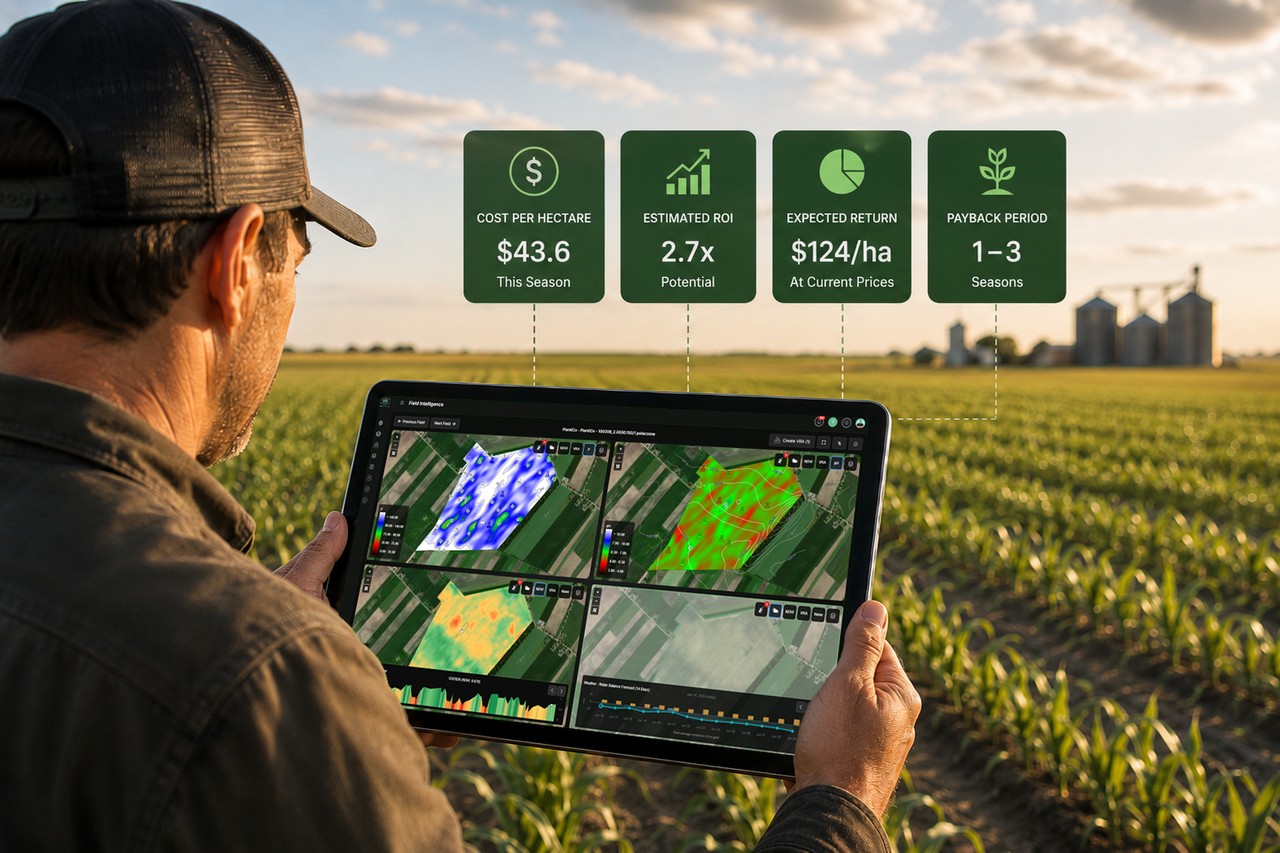
A practical precision farming budget should be built around the decisions a farm wants to improve - not around technology alone.
Precision agriculture costs may include satellite monitoring, weather data, soil mapping, machinery connectivity, variable-rate prescription creation, AI-based advisory support, and implementation time. The return usually comes from input savings, better timing, reduced overlap, improved yield response, and more accurate field-level decisions.
A realistic payback period can range from one season for simple operational savings to two or three seasons for more complete soil, VRA, and AI decision-support programs. The strongest ROI usually appears when the farm connects three things: field variability, economic opportunity, and executable action.
Introduction: Precision Agriculture Is a Budget Decision
Precision agriculture is often described as a technology category. In practice, it is a financial decision.
A farmer, agronomist, dealer, or agricultural service provider should not ask only, “What does precision agriculture cost?” The better question is, “Which field decisions can precision agriculture improve, and what is the economic value of improving them?”
This distinction matters because the cost of precision agriculture varies widely. A basic satellite monitoring tool has a very different cost structure than a complete system that combines high-resolution soil mapping, variable-rate fertilizer prescriptions, machinery data, weather intelligence, and AI-based agronomic recommendations.
The purpose of a precision farming budget is to connect investment to measurable outcomes:
- Lower fertilizer waste
- Better input timing
- Reduced overlap
- Higher yield in constrained zones
- Better scouting priorities
- More accurate variable-rate applications
- Better return on agronomic decisions
- Stronger long-term soil management
When implemented correctly, precision agriculture is not a cost. It becomes a decision infrastructure for the farm.
What Is Included in a Precision Agriculture Cost Breakdown?
The cost of precision agriculture depends on how advanced the implementation is. A complete budget may include software, hardware, field services, data processing, agronomic interpretation, machinery integration, and training.
The main cost categories are:
| Cost Category | What It Includes | Why It Matters |
|---|---|---|
| Field boundaries and mapping | Field outlines, farm structure, GIS setup | Creates the base layer for all field-level analysis |
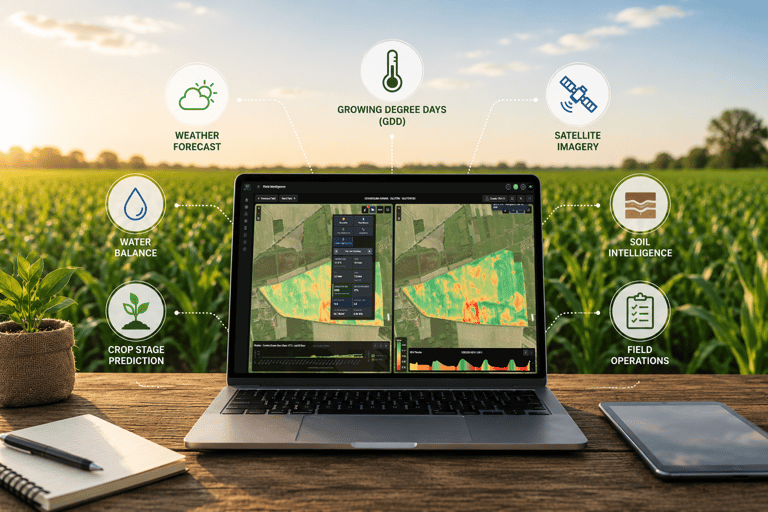
| Satellite monitoring | NDVI, crop vigor, biomass trends, stress detection | Identifies spatial variability and crop development patterns |
| Weather intelligence | Forecasts, rainfall, ET, sprayability, water balance, heat units | Supports timing decisions and risk management |
| Soil data | Soil sampling, soil scanning, lab analysis, calibration, nutrient maps | Defines nutrient variability, pH constraints, and soil-driven yield limits |
| Machinery connectivity | John Deere Operations Center, CNH FieldOps, machine records, application data | Connects recommendations to real field execution |
| Variable-rate prescriptions | Fertilizer, lime, seed, or crop protection prescription maps | Converts data into machine-ready action |
| AI or agronomic advisory | Interpretation, ROI modeling, recommendations, alerts | Helps decide what to do, when to do it, and whether it pays back |
| Training and implementation | Staff time, dealer support, workflow setup | Ensures the system is actually used correctly |
The most common budgeting mistake is to include the software subscription but ignore the cost of implementation. Precision agriculture only creates ROI when the farm can execute the recommendation in the field.
These costs do not include machine investment - a compatible tractor, display, activations, section control, navigation, or a VRA-compatible fertilizer spreader or sprayer. When considering the overall investment, the marginal cost of the software services and the prescriptions becomes negligible.
Three Levels of Precision Farming Budget
A precision farming budget should match the maturity level of the farm.
Level 1: Monitoring Budget
This is the entry level. The farm wants better visibility before changing application rates or machinery workflows.
Typical components:
- Field boundaries
- Satellite imagery
- NDVI and crop vigor maps
- Weather data
- Basic alerts
- Field notes and reports
Main economic value:
- Better scouting
- Earlier stress detection
- Fewer unnecessary field visits
- Better prioritization of problem fields
- Improved understanding of field variability
This level is useful when the farm is starting its digital transition. However, monitoring alone usually has limited ROI unless it leads to a decision.
Level 2: Operational Budget
This level connects field data with machinery and execution.
Typical components:
- Guidance and auto-steering
- Section control
- Machine operation records
- Application maps
- Yield maps
- Equipment platform integration
- Basic VRA capability
Main economic value:
- Reduced overlap
- Fewer missed areas
- Lower fuel and labor waste
- Better documentation
- More accurate application
- Better comparison between planned and executed work
This is where many farms begin to see measurable savings, especially if they operate large areas, irregular fields, or high-cost input programs.
Level 3: Decision-Intelligence Budget
This level connects data, agronomy, and economics.
Typical components:
- High-resolution soil mapping
- Multi-year NDVI analysis
- Weather-based agronomic indices
- Machinery and field operation history
- Variable-rate fertilizer prescriptions
- Economic modeling
- AI-based agronomic recommendations
- Field-specific ROI analysis
Main economic value:
- Fertilizer cost optimization
- Better nutrient allocation
- Yield response in constrained zones
- Better timing of operations
- Lower decision risk
- Improved long-term soil strategy
This is where platforms such as the Terra Oracle AI Advisor become especially relevant. The value is not only in seeing maps. The value is in turning soil, NDVI, weather, operations, and economic context into field-specific recommendations and executable prescription files.
Where Precision Agriculture ROI Comes From
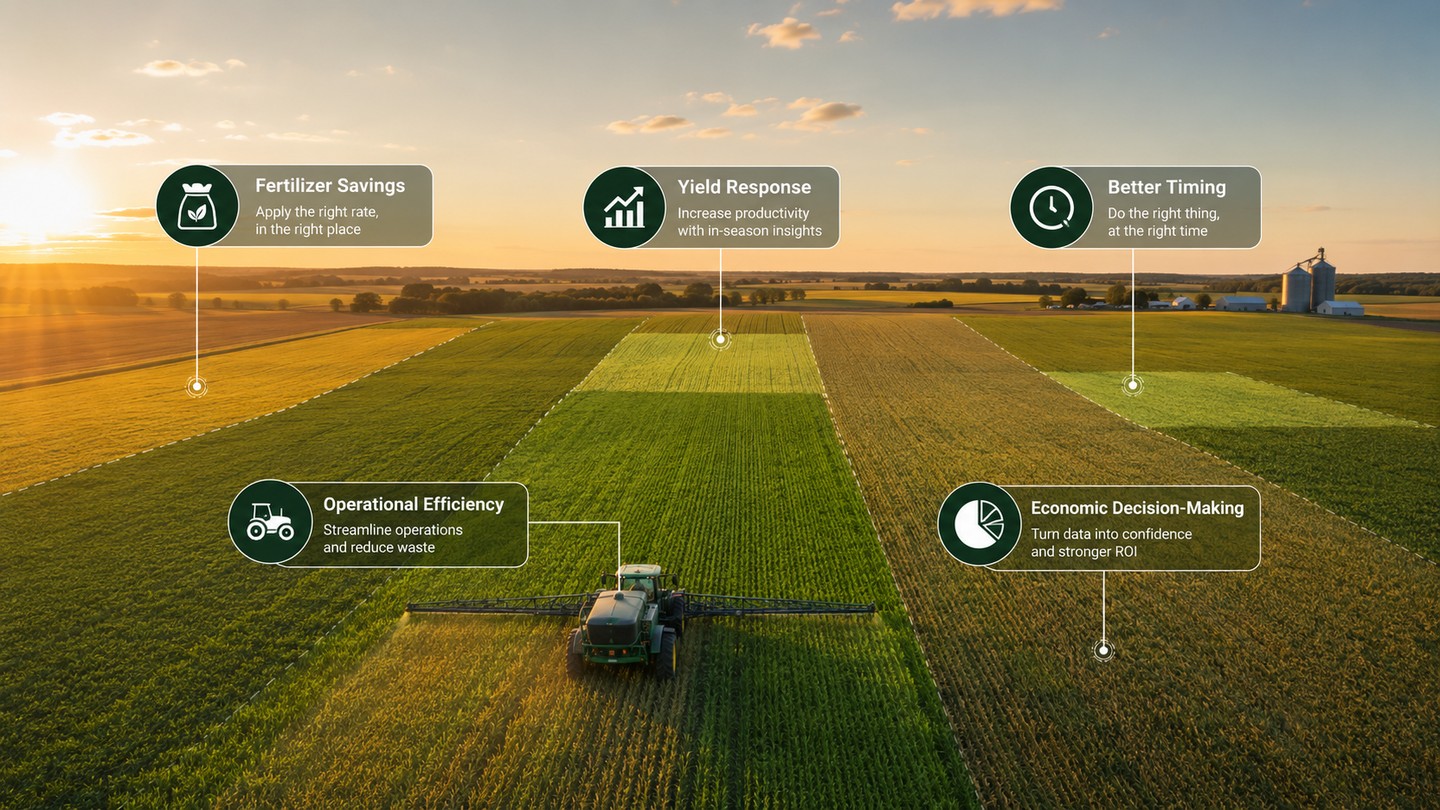
Precision agriculture ROI comes from several sources. The most successful budgets combine multiple return streams instead of relying on only one.
1. Fertilizer and Input Savings
Fertilizer is often one of the largest direct costs in arable farming. Precision agriculture can reduce waste by matching application rates to soil variability, crop demand, and expected return.
Examples of input-related ROI:
- Reducing fertilizer in zones that already have sufficient nutrient levels
- Increasing fertilizer only where crop response is likely
- Avoiding unnecessary lime or nutrient applications
- Adjusting seed rates by productivity zone
- Reducing spray overlap through better control and documentation
Variable-rate fertilizer does not always mean applying less across the whole field. In some cases, the farm may apply the same total amount but redistribute it better. The ROI may come from fertilizer savings, yield response, or both.
Related: The Economics of Variable-Rate Fertilizer .
2. Yield Response
Yield response is the most visible benefit, but it is not always the first or only source of return.
Precision agriculture may improve yield by:
- Correcting pH constraints
- Addressing nutrient deficiencies
- Improving nitrogen timing
- Identifying water stress
- Detecting early crop stress
- Separating soil-driven problems from weather-driven problems
- Prioritizing high-response zones
A small yield gain can be economically meaningful. For example, a 2% yield improvement on a large field or high-value crop can justify a significant portion of the annual precision farming budget.
However, the most professional way to evaluate yield response is by zone, not only by whole-field average. The farm should ask: which zones improved, why did they improve, and did the economic return justify the input?
3. Operational Efficiency
Precision agriculture also reduces operational waste.
Examples include:
- Less overlap in spreading, spraying, and seeding
- Reduced fuel use
- Better labor efficiency
- Fewer unnecessary passes
- Better routing and timing
- More accurate work documentation
- Fewer mistakes when transferring prescription files to machines
These savings are often easier to measure than yield response because they appear directly in field operation records, fuel use, input invoices, and machine data.
4. Better Timing
Timing is one of the most underestimated sources of precision agriculture ROI.
Weather intelligence and field-specific data can help decide:
- When to spray
- When to apply nitrogen
- When to irrigate
- When to delay an operation
- Which field should be prioritized first
- Whether the soil and weather conditions support uptake
A recommendation that prevents one badly timed application can create more value than the annual cost of the software.
For example, if wind, rain, or crop stress conditions make a spray operation ineffective, avoiding that mistake can protect input cost, yield potential, and operational time.
5. Better Decisions Under Price Volatility
Modern farming decisions are made under volatile conditions:
- Fertilizer prices change
- Commodity prices change
- Exchange rates change
- Weather risk changes
- Labor and fuel costs change
This is why the economic layer is important. A recommendation should not only ask, “Is this agronomically correct?” It should also ask, “Does this make financial sense under current conditions?”
The Terra Oracle AI Advisor is designed around this connection: soil, NDVI, weather, operations, and economic context are evaluated together so recommendations can be agronomically sound and economically informed.
Precision Agriculture ROI Formula
A simple way to calculate precision agriculture ROI is:
Precision Agriculture ROI (%) =
((Input Savings + Added Revenue + Operational Savings - Precision Agriculture Cost)
÷ Precision Agriculture Cost) × 100
The payback period is:
Payback Period =
Precision Agriculture Cost ÷ Annual Net Benefit
Where:
Annual Net Benefit =
Input Savings + Added Revenue + Operational Savings - Precision Agriculture Cost
This formula should be calculated per hectare and then scaled to the farm level.
Worked Example: 1,000 ha Farm
Assume a 1,000 ha arable farm wants to create a practical precision farming budget.
The farm already has modern machinery and wants to add:
- Satellite monitoring
- Weather intelligence
- Soil mapping on priority fields
- Variable-rate fertilizer prescriptions
- AI-based agronomic and economic recommendations
- Machinery integration for prescription execution
Traditional Annual Cost Assumption
| Budget Item | Estimated Cost per ha | Total Annual Cost |
|---|---|---|
| Satellite monitoring and crop maps | €3/ha | €3,000 |
| Weather intelligence and agronomic indices | €2/ha | €2,000 |
| Soil mapping and calibration, annualized | €12/ha | €12,000 |
| VRA prescription creation | €4/ha | €4,000 |
| Agronomic advisory decision support | €5/ha | €5,000 |
| Training and implementation | €2/ha | €2,000 |
| Total precision farming budget | €28/ha | €28,000 |
Annual Benefit Assumption
| Benefit Source | Conservative Estimate per ha | Total Annual Benefit |
|---|---|---|
| Fertilizer savings | €14/ha | €14,000 |
| Reduced overlap and operational waste | €5/ha | €5,000 |
| Better timing of applications | €4/ha | €4,000 |
| Yield response or yield protection | €12/ha | €12,000 |
| Better field prioritization | €3/ha | €3,000 |
| Total estimated benefit | €38/ha | €38,000 |
ROI Calculation
Annual benefit = €38/ha
Annual cost = €28/ha
Net benefit = €10/ha

Farm-level annual net benefit =
1,000 ha × €10/ha = €10,000

ROI =
(€38 - €28) ÷ €28 × 100 = 36%

Payback period =
€28 ÷ €10 = 2.8 seasons
In this conservative example, the payback period is just under three seasons.
If fertilizer prices rise, if soil variability is high, or if the farm can generate stronger yield response from VRA and better timing, the payback period can be shorter.
Worked Example: 3,000 ha Dealer or Service-Provider Model
Precision agriculture economics often improve with scale. A dealer, agronomy company, or large farming group can spread fixed costs over more hectares.
Assume a 3,000 ha program that includes:
- Soil scanning or high-resolution soil mapping
- Satellite monitoring
- Weather intelligence
- AI Advisor access
- VRA prescription generation
- Machinery export and execution support
Annual Cost Assumption
| Budget Item | Estimated Cost per ha | Total Annual Cost |
|---|---|---|
| Platform, satellite, weather, and field data | €5/ha | €15,000 |
| Soil mapping and calibration, annualized | €10/ha | €30,000 |
| VRA prescriptions and advisory workflow | €5/ha | €15,000 |
| Training, support, and QA | €2/ha | €6,000 |
| Total precision farming budget | €22/ha | €66,000 |
Annual Benefit Assumption
| Benefit Source | Conservative Estimate per ha | Total Annual Benefit |
|---|---|---|
| Fertilizer optimization | €16/ha | €48,000 |
| Operational savings | €5/ha | €15,000 |
| Yield response or protection | €13/ha | €39,000 |
| Better timing and risk reduction | €4/ha | €12,000 |
| Total estimated benefit | €38/ha | €114,000 |
ROI Calculation
Annual benefit = €38/ha
Annual cost = €22/ha
Net benefit = €16/ha

Farm-level annual net benefit =
3,000 ha × €16/ha = €48,000

ROI =
(€38 - €22) ÷ €22 × 100 = 73%

Payback period =
€22 ÷ €16 = 1.4 seasons
This example shows why scale matters. The same technology stack may look expensive on a small area but very attractive when deployed across a larger commercial operation or dealer service model.
Worked Example: 300 ha Farm Starting Gradually
A smaller farm should not necessarily implement every precision agriculture layer at once.
Assume a 300 ha farm starts with:
- Field boundaries
- Satellite monitoring
- Weather intelligence
- AI-based advisory support
- Soil mapping only on the most variable fields
- VRA on selected fields, not the entire farm
Traditional Annual Cost Assumption
| Budget Item | Estimated Cost per ha | Total Annual Cost |
|---|---|---|
| Satellite and weather platform | €5/ha | €1,500 |
| Agronomic advisory support | €6/ha | €1,800 |
| Soil mapping on priority fields, annualized | €7/ha | €2,100 |
| VRA planning on selected fields | €3/ha | €900 |
| Training and setup | €2/ha | €600 |
| Total precision farming budget | €23/ha | €6,900 |
Annual Benefit Assumption
| Benefit Source | Conservative Estimate per ha | Total Annual Benefit |
|---|---|---|
| Fertilizer savings | €8/ha | €2,400 |
| Better scouting and crop monitoring | €3/ha | €900 |
| Better application timing | €4/ha | €1,200 |
| Yield protection | €7/ha | €2,100 |
| Total estimated benefit | €22/ha | €6,600 |
ROI Calculation
Annual benefit = €22/ha
Annual cost = €23/ha
Net result = -€1/ha in year one
At first glance, this is not attractive. But the lesson is not that precision agriculture does not work for smaller farms. The lesson is that smaller farms need a more focused budget.
For a 300 ha farm, it may be better to:
- Start only with the most variable fields
- Focus on high-value crops
- Use a dealer or service provider instead of buying equipment
- Delay advanced soil mapping until there is a clear VRA opportunity
- Prioritize weather, scouting, and timing decisions first
- Expand only after measurable value is proven
Precision agriculture should scale from evidence, not from assumptions.
Recommended Budget Sequence
The strongest precision farming budget usually follows this order:
flowchart LR
S0["Field Visibility"]
S0 --> S1["Variability Detection"]
S1 --> S2["Soil and Constraint Mapping"]
S2 --> S3["Economic Opportunity Ranking"]
S3 --> S4["VRA and Field Recommendations"]
S4 --> S5["Machine Execution"]
S5 --> S6["ROI Measurement and Expansion"]
This sequence keeps the budget connected to decisions. It avoids the common mistake of buying tools before identifying where the economic return will come from.
How Much Should a Farm Spend on Precision Agriculture?
There is no universal number. A practical budget depends on farm size, crop value, machinery readiness, input cost, and field variability.
As a planning framework:
| Farm Situation | Recommended Budget Logic |
|---|---|
| Low digital maturity | Start with monitoring, field boundaries, and weather |
| High fertilizer cost | Prioritize soil mapping and VRA |
| Strong field variability | Prioritize high-resolution soil and NDVI analysis |
| Modern connected machinery | Prioritize prescription creation and execution |
| Large farm or dealer network | Build an integrated data + AI + VRA workflow |
| High-value crops | Budget more aggressively for monitoring, timing, and targeted intervention |
| Small farm | Start with service-based implementation on priority fields |
A farm should not spend the same amount on every field. The best precision farming budget directs more investment to fields where variability, input cost, and yield opportunity are highest.
Budget Allocation Example
For a farm building a serious precision agriculture program, a balanced budget could look like this:
| Budget Category | Suggested Share |
|---|---|
| Soil data and field mapping | 30-40% |
| Satellite and weather intelligence | 15-20% |
| VRA prescription generation | 15-20% |
| AI / advisory interpretation | 15-25% |
| Training, support, and QA | 5-10% |
If the farm already has strong machinery data and clean field boundaries, more budget can move toward AI advisory and prescription execution.
If the farm has weak soil data, the first investment should usually be soil mapping.
How Terra Oracle AI Supports Precision Agriculture ROI
Terra Oracle AI is designed to help farms and agricultural service providers move from data collection to economically informed action.
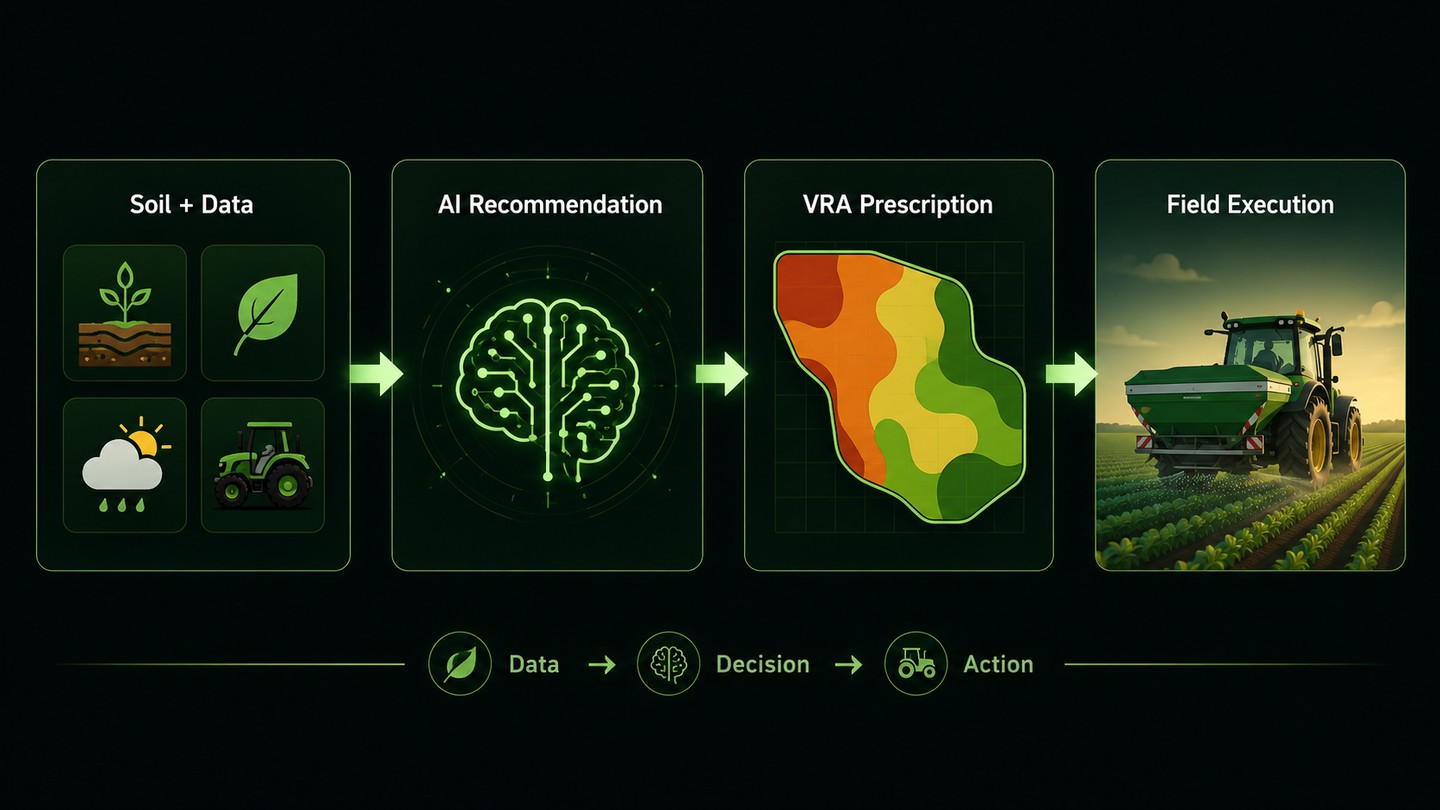
The platform connects:
- Soil intelligence
- Satellite and NDVI history
- Weather forecasts and agronomic indices
- Field operations
- Input and market context
- AI-based reasoning
- Variable-rate prescription outputs
This matters because ROI does not come from one data layer alone.
A satellite image may show crop variability. A soil map may show nutrient or pH differences. Weather data may show whether application timing is suitable. Machinery records may show what was actually applied. Economic data may show whether the expected response justifies the input cost.
The AI Advisor brings these layers together so the farm can ask practical questions:
- Should I apply the same nitrogen rate everywhere?
- Which zones justify more fertilizer?
- Where should I reduce the rate?
- Is the expected yield response worth the input cost?
- Is the weather suitable for this operation?
- Can I generate a variable-rate prescription?
- What is the expected ROI of this recommendation?
This is the difference between precision agriculture as a data expense and precision agriculture as a decision system.
The same 1,000 ha example looks like this under Terra Oracle AI’s current pricing compared with traditional pricing:
| Budget Item | Terra Oracle AI Cost per ha | Total Annual Cost (1,000 ha) | Traditional Pricing |
|---|---|---|---|
| Satellite monitoring and crop maps | €3/ha (free up to 50 ha) | €3,000 | €3,000 |
| Weather intelligence and agronomic indices | Included | - | €2,000 |
| VRA prescription creation | Included | - | €4,000 |
| Training and implementation | Included | - | €2,000 |
| AI / advisory decision support | €90/month | €1,080 | €1,800 |
| Soil mapping and calibration, annualized | €12/ha | €12,000 | €12,000 |
| Total precision farming budget | €15/ha + €1,080 | €16,080 | €28,000 |
Related reading:
- Terra Oracle AI Advisor
- AI Soil Scanner
- The Economics of Variable-Rate Fertilizer
- Calculating ROI on Soil Scanning
- From Scan to Prescription: How Variable Rate Maps Are Generated
What Payback Timeline Should Farmers Expect?
The payback timeline depends on the type of investment.
| Investment Type | Typical Payback Logic |
|---|---|
| Satellite monitoring | Fastest when it improves scouting and timing decisions |
| Weather intelligence | Fastest when spray, irrigation, or nitrogen timing is critical |
| Guidance and section control | Fastest when overlap is high |
| Soil mapping | Strongest when soil variability is a major yield or input-cost driver |
| Variable-rate fertilizer | Strongest when nutrient variability and fertilizer prices are high |
| AI Advisor | Strongest when multiple data layers already exist but decisions are still manual |
| Full connected platform | Strongest for larger farms, dealer networks, and service providers |
A realistic planning range:
- One season: simple operational savings, overlap reduction, improved timing
- One to three seasons: VRA, soil mapping, fertilizer optimization
- Two to five seasons: full digital transformation across many crops and operations
- Longer: if data is collected but does not change field execution
The final point is critical. Precision agriculture does not pay back because the farm has more data. It pays back when the data changes a decision.
Common Budgeting Mistakes
Mistake 1: Buying Technology Before Defining the Problem
A farm should first define the economic problem:
- Fertilizer waste
- Weak zones
- Low pH areas
- Inconsistent crop development
- Poor spray timing
- Overlap
- Unclear yield potential
- Lack of field-level profitability data
Only then should the farm choose the technology.
Mistake 2: Measuring ROI Only by Yield Increase
Yield matters, but it is not the only return. Precision agriculture can also create value through lower input use, better timing, operational efficiency, and risk reduction.
Mistake 3: Treating All Fields Equally
Some fields justify a larger budget. Others should remain at a basic monitoring level.
Prioritize fields with:
- High input cost
- Strong variability
- Historical yield inconsistency
- Known nutrient or pH issues
- High-value crops
- VRA-capable machinery
- Clear operational constraints
Mistake 4: Creating Maps Without Execution
A map is not the final product. The economic value comes when the map becomes a recommendation, a prescription, or a better field operation.
Mistake 5: Ignoring Data Quality
Poor boundaries, inconsistent sampling, uncalibrated soil data, missing operation records, or incorrect machine setup can reduce ROI.
Precision agriculture depends on trustworthy data and repeatable workflows.
A Practical First-Year Budget Plan
A farm implementing precision agriculture for the first time can follow this structure.
Step 1: Select Priority Fields
Choose fields where there is a high probability of return:
- High fertilizer spend
- Visible NDVI variability
- Inconsistent yields
- Soil differences
- Known pH issues
- Large field size
- VRA execution capability
Step 2: Define the Target
Examples:
- Reduce fertilizer cost by 8-12%
- Improve yield in low-performing zones by 2-3%
- Reduce overlap in spreading and spraying
- Improve spray timing
- Generate VRA prescriptions for priority fields
- Identify the top 20% of fields needing intervention
Step 3: Calculate Cost per Hectare
Precision Farming Budget per ha =
Total Precision Agriculture Cost ÷ Managed Area
Step 4: Estimate Return per Hectare
Estimated Return per ha =
Input Savings + Added Revenue + Operational Savings
Step 5: Compare and Decide
Net Benefit per ha =
Estimated Return per ha - Precision Farming Budget per ha
If the net benefit is positive and operational risk is acceptable, the investment is financially justified.
If the net benefit is unclear, start with fewer fields and measure results.
FAQ
What is the cost of precision agriculture?
Precision agriculture cost depends on the level of implementation. Basic monitoring may include field boundaries, satellite imagery, and weather data. More advanced programs include soil mapping, machinery integration, VRA prescription creation, AI advisory support, and implementation services. The best way to evaluate cost is per hectare and per decision.
What is a good precision agriculture ROI?
A good precision agriculture ROI depends on crop value, input prices, field variability, and execution capability. Many farms should aim for measurable payback within one to three seasons, especially for soil mapping, VRA, and input optimization.
How do I build a precision farming budget?
Start with the field problem, not the technology. Identify where the farm loses money or misses opportunity, estimate the value of solving that problem, then budget for the data, tools, advisory support, and execution workflow needed to solve it.
Does precision agriculture always increase yield?
No. Precision agriculture can increase yield in some situations, but it can also improve profitability by reducing waste, improving timing, lowering overlap, or applying inputs more accurately.
What gives the fastest payback?
The fastest payback usually comes from operational savings, better timing, and input optimization. More advanced payback from soil mapping and variable-rate fertilizer depends on field variability, fertilizer prices, and the farm’s ability to execute prescription maps.
Is precision agriculture only for large farms?
No, but farm size affects the budget model. Smaller farms may benefit more from service-based implementation and priority-field deployment, while large farms and dealer networks can spread fixed costs across more hectares.
Conclusion: Budget for Decisions, Not Data
The economics of precision agriculture are strongest when every euro spent is connected to a decision.
A good precision farming budget does not simply purchase maps, dashboards, or data layers. It funds a workflow:
- Understand field variability
- Identify the economic opportunity
- Generate the right recommendation
- Execute it in the field
- Measure the result
- Improve the next decision
That is where precision agriculture ROI comes from.
For farms, dealers, and agricultural service providers, the opportunity is to move from observation to action - and from technology cost to measurable economic return.
With soil intelligence, NDVI history, weather context, operations data, economic modeling, and AI-based recommendations connected in one system, precision agriculture becomes more than a digital tool. It becomes a practical framework for better farming decisions.