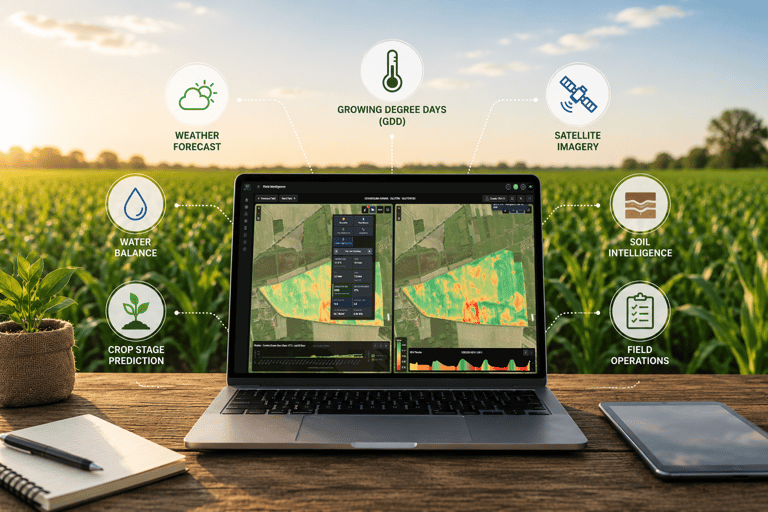
The Economics of Variable-Rate Fertilizer
Learn how variable-rate fertilizer creates ROI through fertilizer cost savings, pH correction, lime optimization, yield response, and high-resolution soil mapping.

Executive summary
Variable-rate fertilizer ROI comes from applying nutrients, lime, or soil amendments according to field variability instead of applying one uniform rate across the whole field.
The economic return can come from five places:
- Reducing fertilizer where soil tests already show sufficient levels.
- Increasing fertilizer where a real deficiency constraint limits yield.
- Improving yield in zones where nutrient or pH correction removes a limiting factor.
- Avoiding wasted applications in zones where extra input is unlikely to generate a crop response.
- Increasing yield as a result of correcting pH by lime application.
The strongest and most defensible economic case is often not “VRA always increases yield.” A better statement is:
Variable-rate fertilizer can improve profitability when it identifies where inputs are economically justified and where they are not.
This is especially important for pH correction and lime application, where spatial variability can cause one part of a field to be acidic and yield-limited while another part does not need lime.
Instead of asking, “Should I apply variable rate?”, farmers should ask, “Can I justify applying the same rate everywhere?”
What Is a Variable-Rate Fertilizer Application?
Variable-rate fertilizer application is the practice of applying fertilizer at different rates within the same field based on soil, crop, yield, or management-zone data. It is different from uniform application, where the same rate is applied everywhere.
In a typical workflow, the farm creates a prescription map. The map tells the spreader, sprayer, or seeder how much product to apply in each part of the field.
Variable-rate fertilizer application can be used for any soil nutrient, depending on your typical fertilization practices, including:
- Nitrogen
- Phosphorus
- Potassium
- Lime - for pH correction
- Sulfur
- Micronutrients
- Seed
- Organic amendments
- Soil correction products
The goal is not automatically to reduce every input. The goal is to apply the right rate in the right zone.
Why the Economics Are Field-Specific
Variable-rate fertilizer application does not have one universal ROI number.
The result depends on:
- Soil variability
- Existing nutrient levels
- Soil pH variability
- Fertilizer and lime prices
- Crop price
- Yield potential
- Crop response to the limiting factor
- Prescription accuracy
- Machinery execution accuracy
- Cost of soil mapping, sampling, analysis, and advisory work
- Existing fertilizing practices and rates
This is why a claim such as “VRA saves 20% fertilizer” is too broad unless it is supported by a specific field dataset.
A more accurate way to evaluate VRA economics is by asking:
Which zones are over-supplied, which zones are under-supplied, and what is the expected crop response from changing the rate?
The Most Reliable ROI Sources
Variable-rate fertilizer can create economic value in several ways. The strength of each source depends on the field.
1. Fertilizer Cost Savings
Fertilizer cost savings occur when the prescription reduces or eliminates application in areas where soil nutrient levels are already sufficient.
This is common in fields with:
- Historical over-application
- Manure history
- Uneven spreading history
- Different previous crops
- Old farmstead or livestock areas
- Variable soil texture
- Variable organic matter
- Different yield removal patterns
In these cases, a uniform recommendation may apply fertilizer to areas where the probability of response is low. VRA can reduce application in those areas while maintaining or increasing rates in deficient areas.
However, the exact saving must be calculated from the field map. It should not be assumed.
2. Yield Response in Deficient Zones
Yield response occurs when VRA increases the rate in areas where nutrient deficiency is limiting crop performance.
This is especially important because fertilizer savings alone can understate the value of VRA. A good prescription may reduce input in high-testing zones and increase input in low-testing zones.
In that case, the total fertilizer bill may stay similar, but the economic return can still improve if yield increases in the previously deficient zones.
The correct economic question is not “Did we apply less fertilizer?” The better question is “Did we apply fertilizer where it was most likely to pay back?”
3. pH Correction and Variable-Rate Lime Application
pH correction is one of the strongest economic cases for variable-rate soil management.
Soil pH affects nutrient availability, root growth, microbial activity, aluminum and manganese toxicity risk in acidic soils, and the effectiveness of applied fertilizer. When pH is too low, a crop may not fully use the nutrients already present in the soil or the fertilizer applied during the season.
This makes lime different from ordinary annual fertilizer.
A phosphorus or potassium prescription mainly adjusts nutrient supply. A lime prescription can remove a soil constraint that affects several nutrients and root-system performance at the same time.
Variable-rate lime is economically important because pH can vary sharply within a field. A uniform lime rate may under-apply lime in acidic zones and over-apply lime in zones that are already near the target pH.
That creates two economic losses:
- The acidic zones may remain yield-limited.
- The high-pH or adequate-pH zones may receive unnecessary lime.
A variable-rate lime prescription can target the correction where it is needed.
For this reason, pH mapping and lime VRA should often be treated as a strategic soil-correction investment, not only as an annual input optimization tool.
4. Better Allocation of the Same Budget
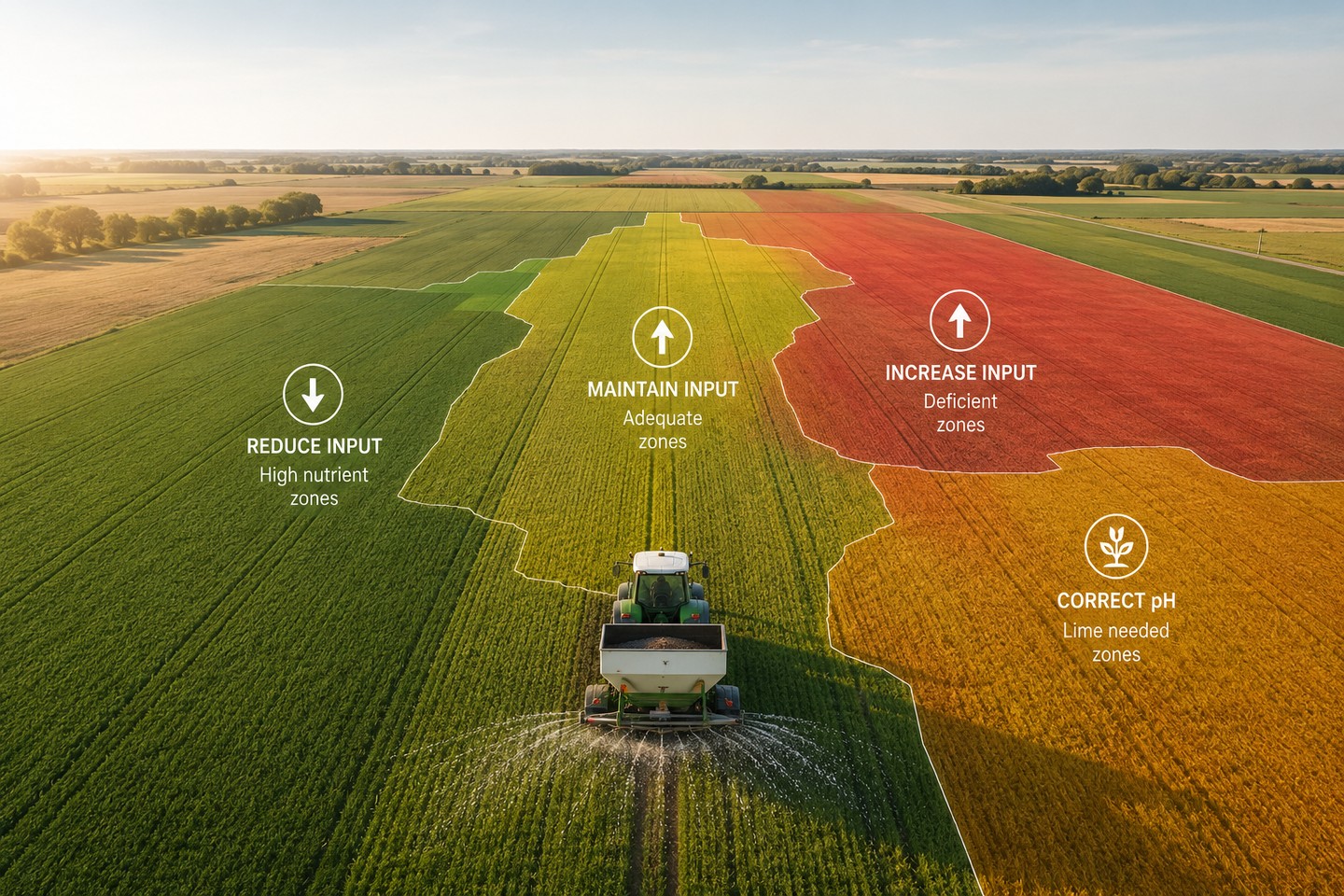
In many cases, VRA does not simply reduce the fertilizer budget. It reallocates the same budget more intelligently.
For example:
- Reduce phosphorus in high-testing zones.
- Increase phosphorus in low-testing zones.
- Reduce potassium where soil K is sufficient.
- Increase potassium where K is limiting crop performance.
- Apply lime only where pH correction is needed.
- Delay or avoid correction where the expected return is weak.
This approach is more realistic than promising a fixed saving percentage.
A strong VRA program should combine:
- Soil-test status
- pH and lime requirement
- Expected yield response
- Input cost
- Crop price
- Machinery capability
- Risk tolerance
- Long-term soil fertility goals
What the Research Shows - and What It Does Not Show
Published research and extension guidance support the logic of site-specific nutrient and lime management, but the economic outcome is not universal.
A key point is that many older and widely cited VRA studies were based on traditional soil sampling approaches: grid sampling, zone sampling, or a limited number of soil samples per field.
This matters because the quality of the prescription depends heavily on the quality and resolution of the input map.
If the soil map is too coarse, it may miss important boundaries. If the map misses the boundary, the prescription may apply the wrong rate in the wrong area.
University of Nebraska CropWatch guidance notes that early variable-rate fertilizer maps were often derived from grid soil samples at average densities of one sample every three to four acres (1.2-1.6 hectares). In Nebraska research, much higher sampling densities were used to approximate true spatial variability, and in some cases lower sampling densities produced inaccurate maps.
This is very important for interpreting VRA research.
If a study finds limited yield response from variable-rate fertilizer, that may be because:
- The field did not have strong nutrient variability.
- The crop was not limited by the nutrient being varied.
- The recommendation algorithm was not optimal.
- The soil sampling resolution was too coarse.
- The yield response was diluted by averaging across the whole field.
- The benefit was input savings rather than yield increase.
- Weather, disease, compaction, or water stress dominated yield.
Therefore, it is not correct to say that VRA always creates yield gains. It is also not correct to say VRA has weak economics in general.
The correct conclusion is:
Variable-rate fertilizer economics depend on whether the system can accurately identify yield-limiting zones, surplus zones, and economically justified correction zones.
Why Traditional Soil Sampling Can Limit VRA ROI
Traditional grid sampling is useful, but it has a resolution problem.
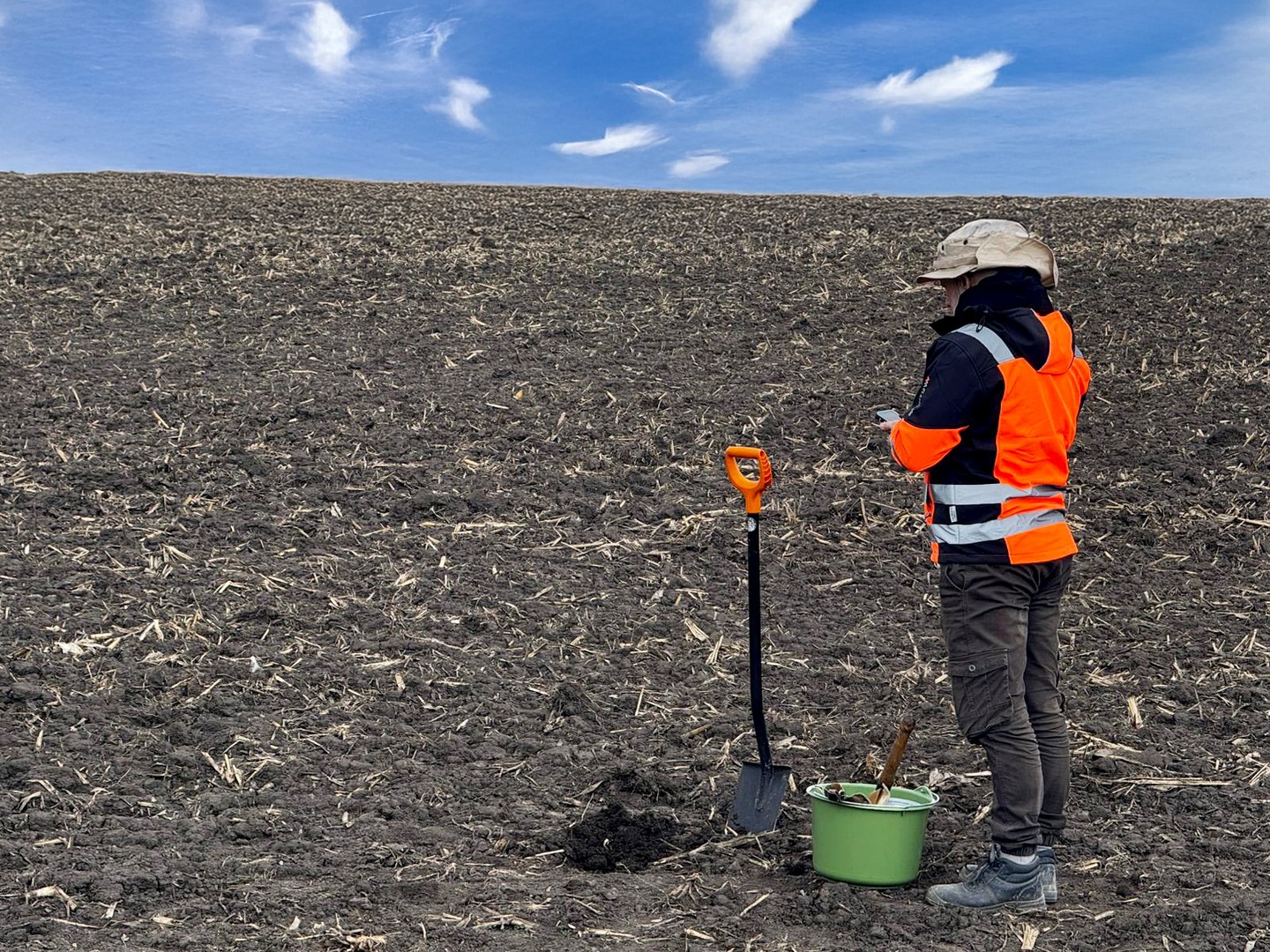
Even a 1-hectare or 2.5-acre grid may represent thousands of square meters with one composite soil sample. That may be enough for broad field fertility planning, but it can miss sharp transitions caused by:
- Old manure application areas
- Former livestock zones
- Variable soil texture
- Erosion
- Drainage patterns
- Headlands
- Old field boundaries
- pH variation
- Localized nutrient accumulation
- Low-productivity patches
University of Nebraska’s precision soil sampling guidance gives examples where sampling density changed the resulting nutrient recommendation. In one Nebraska case, a coarser grid produced a different nitrogen recommendation on 45% of the field compared with the high-density reference; in another case, the difference was smaller, which shows that required sampling density is site-specific.
This supports a practical point:
The value of VRA depends on the quality of the soil variability map.
Why High-Resolution Soil Scanning Can Improve the VRA Case
Continuous soil scanning changes the economics because it can produce much denser soil-variability information than traditional grid sampling alone.
This does not mean every scanned field will automatically show higher ROI. The crop still needs a limiting factor, and the recommendation still needs to be agronomically correct.
But higher-resolution scanning can improve the VRA workflow in several ways:
- It can detect spatial patterns that coarse sampling may miss.
- It can define management zones more accurately.
- It can reduce the risk of averaging high and low zones together.
- It can improve pH correction maps.
- It can help separate nutrient problems from soil-property problems.
- It can support better calibration of lab samples.
- It can make the prescription more field-specific and less dependent on broad assumptions.
In Terra Oracle AI’s case, the soil layer is not treated as an isolated map. The AI Advisor combines soil intelligence with NDVI history, weather, operations, and economics to support variable-rate planning and executable prescription outputs.
In other words:
Existing research proves the logic of site-specific management, but much of it was built on low-resolution soil sampling. Terra Oracle AI aims to improve the practical ROI case by increasing soil-map resolution and connecting the resulting variability map to crop performance, pH correction, input prices, and executable VRA prescriptions.
Worked Example: Variable-Rate Lime and Fertilizer ROI
Assume a 100-hectare (247 acres) wheat field.
The farm currently applies a uniform fertilizer and lime strategy.
After high-resolution soil mapping, the field is divided into four zones:
| Zone | Area | Soil Condition | Recommended Action |
|---|---|---|---|
| Zone A | 25 ha | Low pH, moderate nutrients | Apply lime and maintain fertilizer |
| Zone B | 30 ha | Adequate pH, high P and K | Reduce P and K |
| Zone C | 20 ha | Low K, adequate pH | Increase K |
| Zone D | 25 ha | Low pH and low P | Apply lime and increase P |
Uniform Strategy
The farm applies the same fertilizer and lime rate everywhere.
| Input | Uniform Cost |
|---|---|
| Fertilizer | €300/ha |
| 100 ha total | €30,000 |
Variable-Rate Strategy
The VRA plan reduces unnecessary input in high-testing zones and increases correction where needed.
| Zone | Fertilizer (€/ha) | Lime (€/ha) | Hectares | Total (€) |
|---|---|---|---|---|
| A | 200 | 50 | 25 | 6,250 |
| B | 150 | 0 | 30 | 4,500 |
| C | 250 | 0 | 20 | 5,000 |
| D | 300 | 30 | 25 | 8,250 |
| Soil analysis | €40 per hectare | 4,000 | ||
| Total | 28,000 |
In this example, the direct first-year saving is:
Uniform program: €30,000
VRA program: €28,000
Direct saving: €2,000
At first glance, this is modest.
But the real ROI may come from correcting pH-limited zones.
Assume 40 ha had low pH. After lime correction, these zones produce a conservative additional 0.25 t/ha compared with leaving the pH problem untreated.
Assume wheat price is €200/t.
Yield response area: 40 ha
Yield response: 0.25 t/ha
Crop price: €200/t

Additional revenue =
40 × 0.25 × €200 = €2,000
Total economic effect:
Direct input saving: €2,000
Additional revenue: €2,000
Total benefit: €4,000
Mapping and prescription cost already included
Net benefit vs uniform: €4,000
This example shows why pH correction can be more economically important than simple nutrient reduction.
The goal is not only to save fertilizer. The goal is to remove the most profitable soil constraint.
VRA ROI Formula
Use this formula for variable-rate fertilizer ROI:
VRA ROI =
(Input Savings + Added Revenue + Avoided Waste - VRA Program Cost)
÷ VRA Program Cost
Where:
- Input savings = reduced fertilizer, lime, or amendment use in zones that do not need it.
- Added revenue = yield response from correcting deficient or pH-limited zones.
- Avoided waste = input not applied where response probability is low.
- VRA program cost = soil mapping, lab calibration, prescription creation, data processing, and advisory work.
A practical version per hectare:
Net VRA Benefit per ha =
Fertilizer Savings per ha
+ Lime Savings per ha
+ Yield Response Revenue per ha
- Mapping and Prescription Cost per ha
What Farmers Should Measure
A professional VRA economic analysis should measure more than total fertilizer applied.
Track:
- Total fertilizer cost
- Total lime cost
- Cost per hectare
- Rate by zone
- Soil pH before and after correction
- Soil P and K before and after correction
- Yield by zone
- NDVI trend by zone
- Crop response in corrected zones
- Prescription execution accuracy
- Weather impact during the season
- Input prices and crop prices
The most important measurement is zone-level performance.
Whole-field averages can hide the economic value of correcting specific zones.
Practical Interpretation
Variable-rate fertilizer is most likely to pay when:
- Soil variability is high.
- pH variability is high.
- Some zones are clearly over-supplied.
- Some zones are clearly deficient.
- Lime requirement varies strongly across the field.
- Fertilizer or lime prices are high.
- The crop has strong response potential.
- The farm can execute prescription maps accurately.
- The soil map has enough resolution to define meaningful zones.
Variable-rate fertilizer is less likely to pay when:
- The field is already uniform.
- Nutrient levels are already near optimum everywhere.
- pH is already within target range across the field.
- Yield is mainly limited by water, compaction, disease, or drainage.
- Prescription maps are based on weak or low-resolution data.
- Machinery cannot execute the prescription accurately.
The Role of Terra Oracle AI
Terra Oracle AI is designed to improve the full VRA decision workflow.
The platform connects:
- High-resolution soil mapping
- Nutrient and pH variability analysis
- NDVI history
- Weather context
- Field operations
- Economic modeling
- AI-based recommendations
- VRA prescription outputs
This matters because the best VRA decision is not only a soil decision.
A field may show low potassium, but if drought stress is the real yield-limiting factor, the economic case for potassium correction may be weaker. Another field may show moderate nutrients but severe pH limitation, making lime correction the better investment.
The AI Advisor helps evaluate these interactions.
Instead of asking only “Where should I reduce fertilizer?”, the better question is “Where will fertilizer, lime, or soil correction create the highest economic return?”
That is the real economics of variable-rate fertilizer.
Learn more:
FAQ
What is variable rate fertilizer ROI?
Variable rate fertilizer ROI is the financial return from applying fertilizer or soil amendments at different rates within a field. ROI comes from input savings, yield response, avoided over-application, and better correction of limiting zones such as low-pH areas.
Does variable-rate fertilizer always save fertilizer?
No. In some fields, VRA reduces total fertilizer use. In other fields, it redistributes the same amount of fertilizer more effectively. The economic goal is not always lower input use. The goal is better return on each unit of input.
Does VRA always increase yield?
No. Yield response is field-specific. VRA is most likely to increase yield when it corrects a real limiting factor such as nutrient deficiency, low pH, or poor soil condition. In other cases, the main benefit may be reduced waste or better long-term soil management.
Why is pH correction important for VRA economics?
pH affects nutrient availability, root growth, and the ability of the crop to use fertilizer. Correcting low-pH zones can improve the effectiveness of other nutrients. This makes variable-rate lime one of the strongest economic use cases for high-resolution soil mapping.
Why does soil-map resolution matter?
A VRA prescription is only as good as the map behind it. Coarse grid sampling can miss important soil boundaries. Higher-resolution soil sensing can improve zone definition and reduce the risk of applying the wrong rate in the wrong place.
Is high-resolution soil scanning proven to improve VRA ROI?
The general logic is strong: better soil maps should support better zone definition and better prescriptions. However, ROI still depends on field variability, crop response, input prices, and execution. High-resolution scanning should be evaluated with field-level and zone-level results.
Conclusion
The economics of variable-rate fertilizer are not based on one universal saving percentage.
The real value comes from matching the input to the field condition:
- Reduce fertilizer where response probability is low.
- Increase fertilizer where deficiency limits yield.
- Apply lime where pH correction is needed.
- Avoid lime where pH is already adequate.
- Use yield, NDVI, weather, and operational data to validate the result.
The strongest case for VRA is not simply “use less fertilizer.” It is: use the right input, at the right rate, in the right zone, where the expected return justifies the cost.
Traditional VRA research has often relied on grid or zone sampling. That research supports the logic of site-specific management, but it also shows why map quality matters. With higher-resolution soil scanning and AI-based decision support, farms can move beyond broad field averages and build more precise, economically grounded prescriptions.
That is where variable-rate fertilizer becomes more than a technology feature. It becomes a practical ROI tool.
References
- Grisso, R., Alley, M., Thomason, W., Holshouser, D., & Roberson, G.T. (2011). Precision Farming Tools: Variable-Rate Application . Virginia Cooperative Extension, Publication 442-505.
- University of Nebraska-Lincoln CropWatch. Soil Sampling for Precision Agriculture . See also: Valente, D.S.M., et al. (2024). Accuracy of Various Sampling Techniques for Precision Agriculture: A Case Study in Brazil . Agriculture, 14(12), 2198.
- Thomas, G.W. (1996). Soil pH and Soil Acidity . In Methods of Soil Analysis, Part 3: Chemical Methods (pp. 475-490). SSSA Book Series. Madison, Wisconsin: Soil Science Society of America.