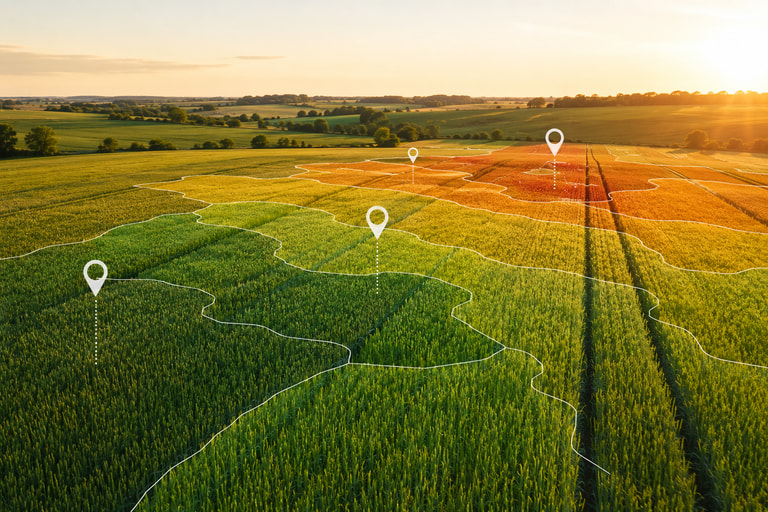
Soil Water Balance for Irrigation Decisions
Learn how soil water balance, water balance index, weather data, crop evapotranspiration, and soil intelligence support better irrigation scheduling decisions.
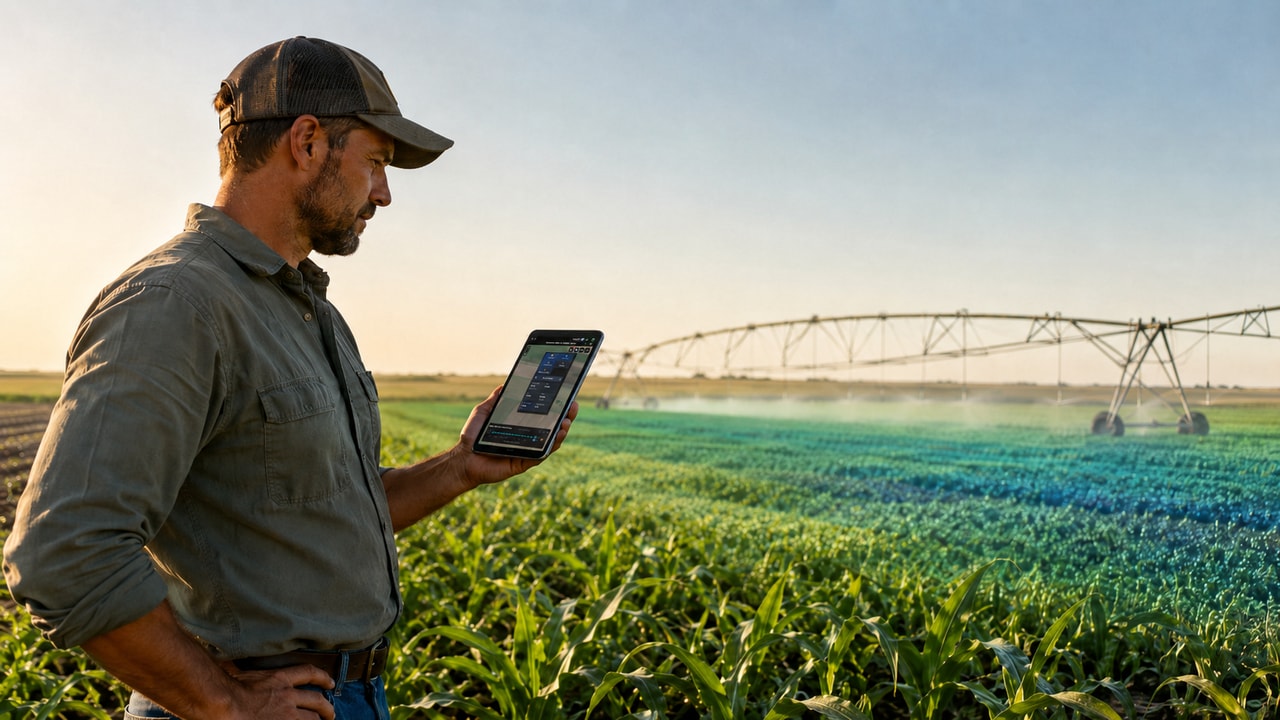
Irrigation timing is one of the most important decisions in crop production. Apply water too late, and the crop may enter stress before visible symptoms appear. Apply too much or too early, and water, energy, nutrients, and labor may be wasted.
A soil water balance gives farmers and agronomists a practical way to answer two questions:
- When is irrigation needed?
- How much water should be applied?
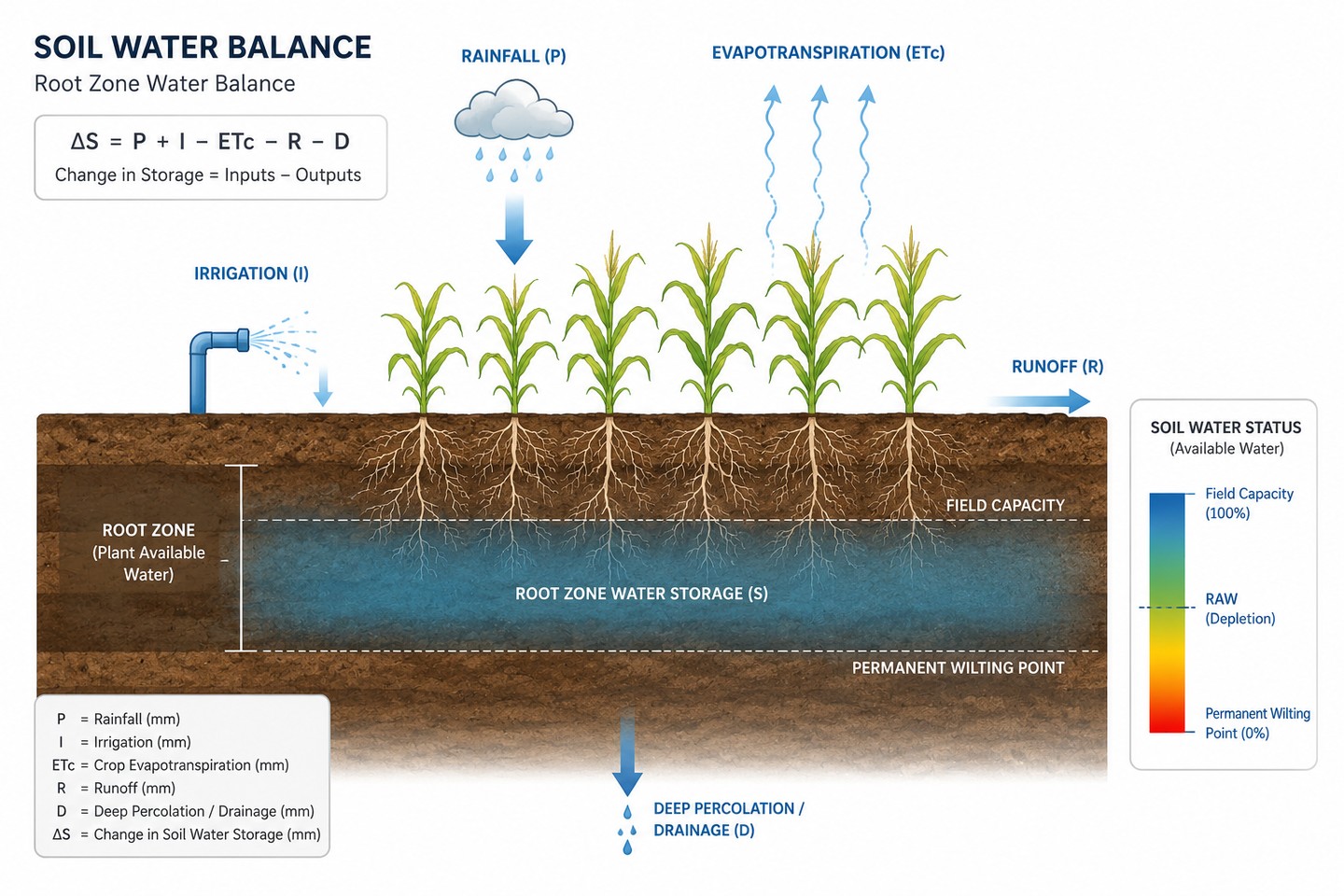
At its simplest, soil water balance works like a field-level water account. Rainfall and irrigation add water to the crop root zone. Evapotranspiration, runoff, drainage, and deep percolation remove water. The objective is to keep the crop within a productive moisture range: not too dry, not saturated, and not wasting water below the active root zone.
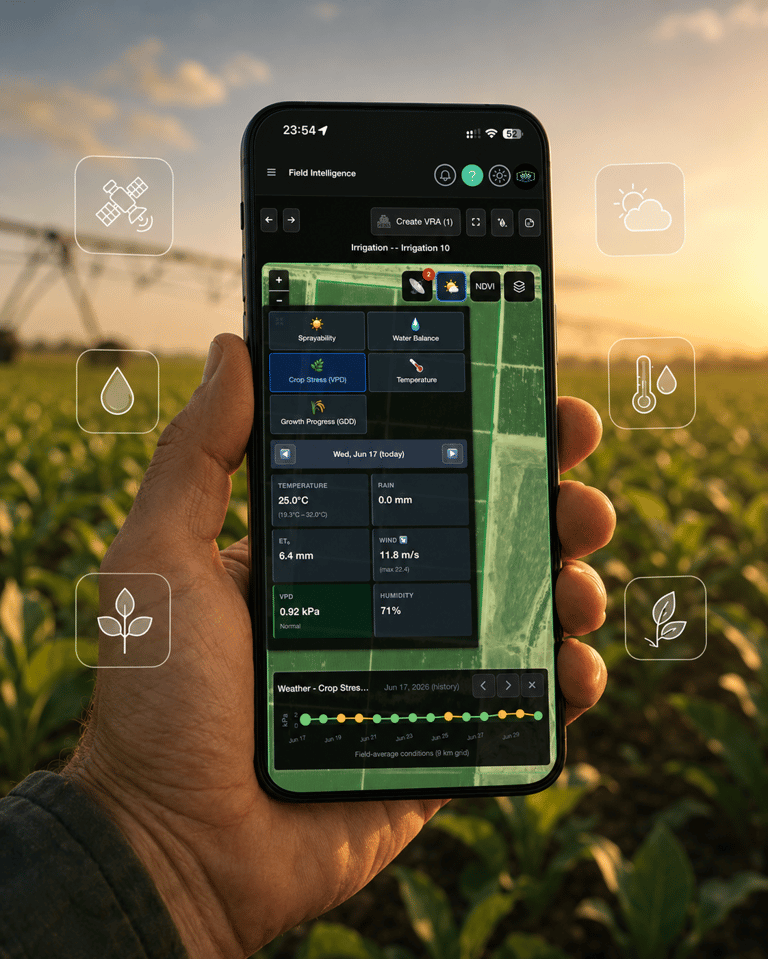
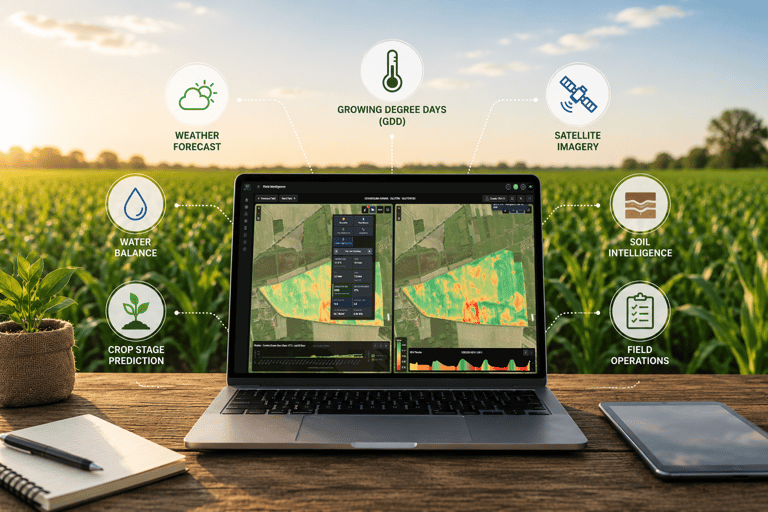
For Terra Oracle AI, soil water balance is not just a weather calculation. It becomes more valuable when it is connected to soil variability, satellite signals, weather forecasts, terrain, crop stage, and field operations. This is where a water balance index can help turn raw data into a clear irrigation decision.
What Is Soil Water Balance?
Soil water balance is the accounting of water entering and leaving the crop root zone over time.
The basic concept is:
Soil water today = soil water yesterday + rainfall + irrigation − crop water use − runoff − deep drainage
In agronomic terms, the major components are:
- Rainfall: natural water input.
- Irrigation: applied water input.
- Crop evapotranspiration: water lost through crop transpiration and soil evaporation.
- Runoff: water that leaves the field surface instead of entering the soil.
- Deep percolation or drainage: water that moves below the active root zone.
- Root-zone storage: the amount of plant-available water that the soil can hold.
- Soil texture and structure: major factors affecting infiltration, water-holding capacity, drainage, and crop access to water.
- Crop stage and rooting depth: determine how much water the crop can access and how sensitive it is to stress.
A useful soil water balance is not only a theoretical equation. It is a decision-support layer that helps determine whether the field is in a safe moisture zone, approaching stress, or already below the preferred threshold.
Why Soil Water Balance Matters for Irrigation Scheduling
Many irrigation decisions are still made by calendar, habit, visual crop appearance, or simple weather checks. These methods can work in some situations, but they often miss the real field condition.
A crop can be under water stress before visible wilting appears. At the same time, a field may look dry on the surface while the root zone still contains enough plant-available water. Soil water balance helps avoid both errors.
For irrigation scheduling, the water balance approach helps answer:
- Has recent rainfall actually reduced the irrigation need?
- Is forecasted rain enough to delay irrigation?
- Is high evapotranspiration increasing crop water demand?
- Is the root zone approaching the allowable depletion threshold?
- How much water is needed to refill the effective root zone without overirrigating?
- Is the field losing water quickly because of soil type, slope, shallow rooting, or drainage?
This makes soil water balance useful for daily irrigation decisions, seasonal water planning, drought management, and comparison between fields.
The Main Inputs Behind a Water Balance Index
A water balance index is a simplified agronomic indicator that converts several water-related variables into an easy-to-understand score or status.
The exact calculation can vary by crop, region, irrigation system, and platform. In practice, a good water balance index should consider the following inputs.
1. Weather Data
Weather is the driver of daily crop water demand. Important variables include:
- Temperature
- Solar radiation
- Wind speed
- Humidity
- Rainfall
- Forecasted rainfall
- Reference evapotranspiration, often called ETo
Reference evapotranspiration estimates the atmospheric demand for water from a standardized reference surface. Crop evapotranspiration is then estimated using crop coefficients that adjust the reference value to a specific crop and growth stage.
2. Crop Type and Growth Stage
Different crops use water differently. A young crop with limited canopy cover has different water demand than a fully developed crop. Rooting depth also changes during the season.
A strong irrigation scheduling system must adjust water balance according to:
- Crop type
- Planting date
- Growth stage
- Canopy development
- Effective rooting depth
- Crop sensitivity to water stress
This is why a generic weather forecast is not enough. The same weather condition can mean different irrigation decisions for wheat, maize, vegetables, orchards, potatoes, or cotton.
3. Soil Water-Holding Capacity
Soil controls how much water can be stored and made available to the crop. Sandy soils usually hold less plant-available water and drain faster. Clay and loam soils may hold more water, but infiltration and aeration must also be considered.
Important soil properties include:
- Texture
- Organic matter
- Bulk density
- Compaction
- Infiltration rate
- Field capacity
- Permanent wilting point
- Available water capacity
- Salinity risk
- Drainage behavior
Without soil context, irrigation scheduling can become too general. Two fields with the same crop and weather may require different irrigation timing because their soils store and release water differently.
4. Rainfall and Irrigation Events
A water balance model must account for water added to the field. However, not every millimeter of rainfall or irrigation becomes useful crop water.
Some water may be lost to:
- Runoff
- Evaporation from the soil surface
- Drainage below the root zone
- Uneven irrigation distribution
- Poor infiltration
- Application inefficiency
This is why irrigation scheduling should not only ask how much water was applied. It should ask how much water became effective in the crop root zone.
5. Satellite and Vegetation Indices
Satellite imagery can help detect crop development, canopy variation, and possible stress patterns. NDVI and other vegetation indices are useful because they provide spatial context across the field.
However, NDVI alone does not prove water stress. Low vegetation index values may be caused by many factors, including soil variability, nutrient deficiency, disease, compaction, salinity, poor emergence, or previous field operations.
The best use of satellite data is not as a standalone irrigation trigger, but as an additional layer that helps explain where water balance may be affecting crop performance.
6. Terrain and Field Variability
Water does not behave uniformly across a field. Elevation, slope, drainage patterns, depressions, and compacted zones can all influence water availability.
A low area may remain wet longer after rainfall. A slope or sandy ridge may dry faster. A compacted zone may limit infiltration even when water is applied. This is why sub-field interpretation is important for irrigation decisions.
7. Soil Moisture Measurements
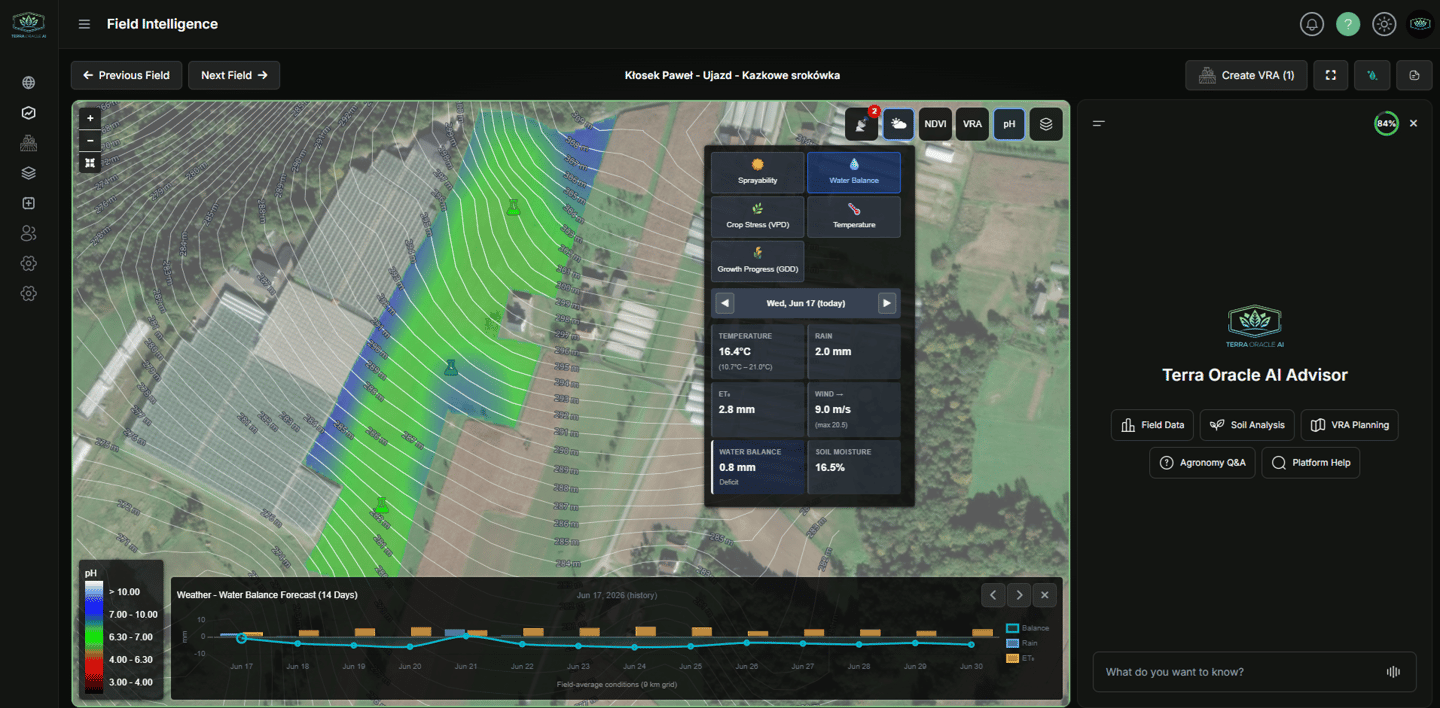
Soil moisture sensors can provide direct information from the root zone. They are especially valuable when calibrated correctly and placed in representative locations.
However, a sensor measures one location or a limited zone. In variable fields, sensor placement matters. A water balance model can help interpret whether a sensor reading represents the whole field, a management zone, or only a specific soil condition.
The strongest approach is often not “model or sensor.” It is model plus sensor validation, connected with soil maps, satellite imagery, and weather.
Soil Water Balance vs Soil Moisture: What Is the Difference?
Soil moisture is a measurement or estimate of how much water is currently in the soil.
Soil water balance is a dynamic calculation of how the water level changes over time.
In simple terms:
- Soil moisture tells you the current status.
- Soil water balance tells you how the status got there and where it is likely going.
- Irrigation scheduling uses both to decide when and how much to irrigate.
For example, a soil moisture sensor may show that a field is still within the acceptable range today. But if the forecast shows high evapotranspiration for the next three days and no rainfall, the water balance may show that irrigation will be needed soon.
This forward-looking capability is one of the main advantages of water balance for irrigation decisions.
How Soil Water Balance Supports Irrigation Timing
A practical irrigation decision normally depends on a threshold.
The field does not need irrigation every time water is used. It needs irrigation when the root-zone depletion approaches a level that may reduce crop performance or create unacceptable risk.
This threshold is often described as management allowable depletion. It represents the amount of plant-available water that can be used before irrigation should be applied.
The logic is:
- Estimate the total plant-available water in the root zone.
- Define the allowable depletion threshold for the crop and stage.
- Track daily water losses from evapotranspiration.
- Add effective rainfall and irrigation.
- Trigger irrigation when the field approaches the threshold.
- Apply enough water to refill the effective root zone without causing drainage losses.
This approach improves irrigation timing because it connects crop demand, soil capacity, and weather conditions into one decision framework.
Practical Example: Turning Water Balance Into a Decision
Imagine a field with a crop that has an active root zone capable of storing 100 mm of plant-available water. The grower decides that irrigation should be triggered when 50 mm has been depleted.
At the start of the week, the soil is near field capacity.
Over the next four days:
- The crop uses 6 mm per day through evapotranspiration.
- No effective rainfall occurs.
- The soil water deficit increases by 24 mm.
The field is not yet at the irrigation threshold. But the forecast shows hot, windy conditions and another 7 mm per day of crop water demand for the next four days.
Without irrigation, the deficit could reach approximately 52 mm by the end of the period. That means the field may cross the allowable depletion threshold before the next practical irrigation window.
The decision may be:
- Irrigate before the high-demand period.
- Apply only enough water to refill the managed root zone.
- Delay if reliable rainfall is expected.
- Prioritize a more sensitive crop or faster-drying soil zone first.
This is the value of water balance. It helps convert weather, soil, crop, and timing into a practical recommendation.
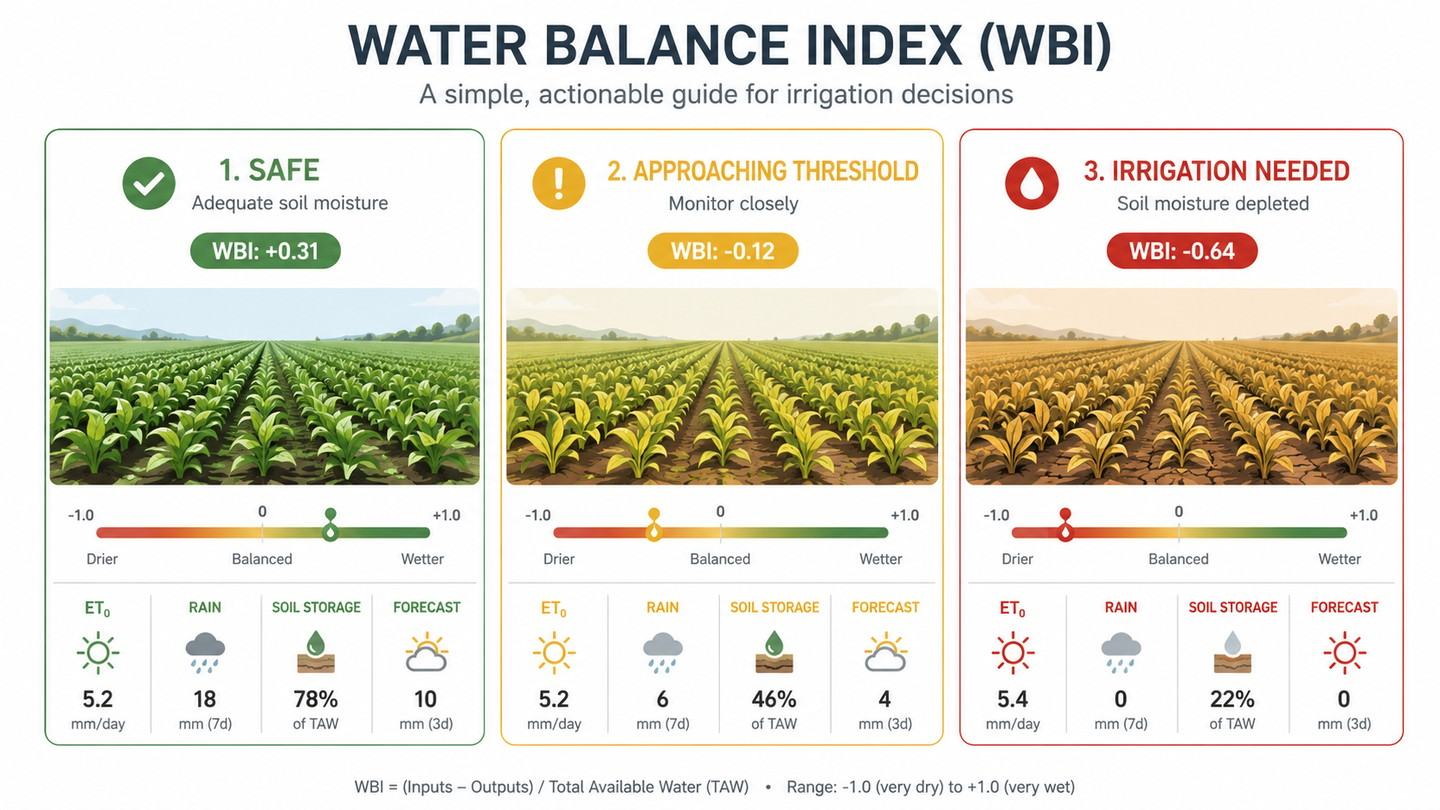
Why a Water Balance Index Is Easier to Use
Farmers and agronomists do not always need to see every calculation. They need a clear and explainable status.
A water balance index can translate complex data into a simple signal, for example:
- Green: moisture status is within the preferred range.
- Yellow: the field is approaching irrigation threshold.
- Red: irrigation should be considered urgently, or the field may already be under water stress.
The important point is that the index should be explainable. A grower should be able to ask:
- Why is this field yellow?
- Is the limiting factor high evapotranspiration, low rainfall, shallow soil, crop stage, or forecasted heat?
- How many days are left before the irrigation threshold is reached?
- How much water is needed?
- Is the recommendation different between zones?
An index without explanation can become another black box. An explainable water balance index becomes a decision tool.
Common Mistakes in Irrigation Scheduling
Mistake 1: Irrigating by Calendar Only
Calendar-based irrigation ignores changes in weather, crop stage, rainfall, and soil storage. It may apply too much water in cool or wet periods and too little water during hot, windy periods.
Mistake 2: Looking Only at Surface Dryness
The soil surface can dry quickly, but the active root zone may still contain available water. Irrigating only because the surface looks dry can waste water.
Mistake 3: Ignoring Soil Variability
One field can contain several soil conditions. A uniform irrigation decision may overwater some zones while under-watering others.
Mistake 4: Using NDVI as a Direct Water-Stress Indicator
NDVI can show crop variability, but it does not explain the cause by itself. Water stress, nutrient deficiency, disease, compaction, salinity, and crop emergence issues can create similar visual patterns.
Mistake 5: Treating Rainfall as Fully Effective
Not all rainfall enters and remains in the root zone. Intensity, slope, soil cover, infiltration, compaction, and current moisture status affect how much rainfall becomes useful crop water.
Mistake 6: Ignoring the Forecast
Irrigation decisions are forward-looking. A field may be acceptable today but may cross the stress threshold in two or three days if evapotranspiration is high and no rain is expected.
How Terra Oracle AI Uses Water Balance in Agronomic Decision-Making
Terra Oracle AI connects water balance with broader field intelligence.
Instead of treating irrigation as a standalone weather calculation, the platform can interpret water status together with:
- Soil intelligence
- Satellite imagery and vegetation indices
- Weather history and forecast
- Terrain and field variability
- Crop stage
- Field operations
- Agronomic risks
- Economic context
The result is a more complete irrigation decision.
For example, if a field shows low NDVI in a specific area, the AI Advisor can help evaluate whether the pattern is likely related to water limitation, nutrient status, soil variability, compaction, terrain, or another agronomic factor.
This is especially important because irrigation decisions rarely happen in isolation. Water availability affects nutrient uptake, crop protection timing, machinery access, root activity, and yield potential.
The Terra Oracle AI Advisor helps turn this connected data into field-specific, explainable recommendations. Instead of only showing a number, it can explain the reason behind the recommendation and help the user understand the next best action.
Learn more: Terra Oracle AI Advisor
How Soil Water Balance Connects With Nutrient Decisions
Water management and nutrient management are closely connected.
Too little water can limit nutrient uptake even when soil nutrient levels are adequate. Too much water can increase leaching risk, reduce aeration, and create inefficient fertilizer use. In fertigated systems, irrigation timing directly affects nutrient delivery.
A soil water balance layer can help answer:
- Is nutrient uptake limited by dry root-zone conditions?
- Is there a risk of nitrate leaching after heavy irrigation or rainfall?
- Should fertigation be delayed because rain is expected?
- Are low-performing zones caused by water, nutrients, or both?
- Should irrigation timing be adjusted before a fertilizer application?
This is where soil water balance becomes part of a larger agronomic reasoning system, not just an irrigation calculator.
When Soil Water Balance Is Most Valuable
Soil water balance is useful in almost every irrigated system, but it is especially valuable when:
- Water is limited or expensive.
- Energy costs are high.
- Weather is unstable.
- Fields have variable soil types.
- Irrigation capacity is limited.
- Crops are sensitive to stress at specific growth stages.
- Fertigation is used.
- Rainfall events are irregular.
- The grower manages many fields and needs prioritization.
- The objective is not only yield, but margin, water efficiency, and operational discipline.
In these situations, a water balance index can help prioritize which field should be irrigated first, which irrigation can be delayed, and where additional field inspection may be needed.
What Makes a Good Soil Water Balance System?
A good water balance system should be:
Field-Specific
It should account for the field’s soil, crop, weather, and management conditions.
Dynamic
It should update as weather, rainfall, irrigation, crop stage, and soil conditions change.
Explainable
It should show why the irrigation recommendation changed.
Forward-Looking
It should use forecasted weather and expected crop water demand, not only past data.
Spatially Aware
It should recognize that fields are not uniform.
Actionable
It should support a clear decision: irrigate, delay, inspect, adjust amount, or prioritize another field.
Soil Water Balance and the Future of AI Irrigation Scheduling
The future of irrigation scheduling is not one data source. It is the integration of many signals into a practical decision system.
Weather data estimates atmospheric demand. Soil data explains storage and access. Satellite imagery shows crop response and spatial variability. Sensors validate root-zone conditions. Operations data tells what was actually done. AI reasoning connects these signals and explains what they mean.
That is the shift from monitoring to decision intelligence.
For growers, the benefit is simple: better irrigation decisions with less guesswork.
For agronomists, the benefit is stronger interpretation: not only where the crop is stressed, but why.
For large farms and service providers, the benefit is prioritization: which fields need attention first, which decisions are urgent, and which actions can safely wait.
FAQ
What is soil water balance?
Soil water balance is the calculation of water entering and leaving the crop root zone. It considers rainfall, irrigation, evapotranspiration, runoff, drainage, and soil water storage to estimate whether the crop has enough available water.
What is a water balance index?
A water balance index is a simplified indicator that converts soil water balance data into an easy-to-understand status or score. It helps show whether the field is within the preferred moisture range, approaching stress, or needs irrigation attention.
How does soil water balance help irrigation scheduling?
Soil water balance helps determine when irrigation is needed and how much water should be applied. It tracks crop water use, rainfall, irrigation, and root-zone depletion so irrigation can be timed before the crop enters damaging water stress.
Is soil water balance better than soil moisture sensors?
They are complementary. Soil moisture sensors provide direct measurements from specific locations. Soil water balance provides a dynamic field-level calculation and can forecast future water status using weather and crop demand.
Can satellite NDVI show water stress?
NDVI can show crop variability, but it does not prove water stress by itself. Low NDVI can also result from nutrient deficiency, disease, compaction, salinity, poor emergence, or soil variability. NDVI is most useful when combined with soil, weather, terrain, and field history.
What data is needed for irrigation scheduling?
Useful irrigation scheduling data includes crop type, growth stage, rooting depth, weather, rainfall, evapotranspiration, soil water-holding capacity, irrigation events, soil moisture, satellite imagery, and field variability.
Why should irrigation decisions use weather forecasts?
Forecasts help predict whether the field will cross a stress threshold in the coming days. A field may be safe today but require irrigation soon if high evapotranspiration and no rainfall are expected.
Conclusion
Soil water balance turns weather, soil, crop stage, and field operations into a practical irrigation decision: when to irrigate, how much to apply, and which fields to prioritize.
The strongest systems are explainable and field-specific. They connect atmospheric demand with root-zone storage, use forecasts, and interpret spatial variability instead of treating the whole field as uniform.
Learn more:
References
- Allen, R.G., Pereira, L.S., Raes, D., & Smith, M. (1998). Crop Evapotranspiration: Guidelines for Computing Crop Water Requirements . FAO Irrigation and Drainage Paper 56. Rome: FAO.
- Pereira, L.S., Paredes, P., & Jovanovic, N. (2020). Soil water balance models for determining crop water and irrigation requirements and irrigation scheduling focusing on the FAO56 method and the dual Kc approach . Agricultural Water Management, 241, 106357.
- University of Minnesota Extension. Evapotranspiration-based irrigation scheduling or the water balance method .
- Colorado State University Extension. Irrigation scheduling: the water balance approach .
- Oregon State University Extension. Irrigation water scheduling (EM 9717).
- Ferreira, M.I. (2017). Stress coefficients for soil water balance combined with water stress indicators for irrigation scheduling of woody crops . Horticulturae, 3(2), 38.
- Kharrou, M.H., et al. (2021). Assessing irrigation water use with remote sensing-based soil water balance at an irrigation scheme level in a semi-arid region of Morocco . Remote Sensing, 13(6), 1133.