The Sprayability Index, Explained
Learn what the sprayability index means, how spraying conditions are calculated, which weather factors matter, and how farmers can use spray windows to improve application timing.

Quick Answer
The sprayability index is an agronomic weather index that helps farmers and agronomists decide whether field conditions are suitable for spraying.
It combines key weather factors such as wind speed, wind direction, rain risk, temperature, humidity, and sometimes inversion risk to estimate whether a spray operation is likely to be safe, effective, and practical.
A high sprayability score means the field is likely within a good spray window. A low score means spraying should usually be delayed, adjusted, or reviewed more carefully because of drift risk, rain wash-off risk, poor deposition, heat stress, or unsuitable operating conditions.
The sprayability index does not replace the product label, local regulations, or professional agronomic judgment. It helps identify better timing.
Why Spray Timing Matters
Spraying is one of the most time-sensitive field operations in agriculture.
A crop protection product may be agronomically correct, but if it is applied under poor weather conditions, the result can be weak performance, wasted input, crop injury, drift, environmental risk, or the need for re-application.
The same product can perform very differently depending on:
- Wind speed
- Wind direction
- Rain before or after application
- Temperature
- Relative humidity
- Leaf wetness
- Spray droplet size
- Boom height
- Nozzle type
- Crop canopy
- Application volume
- Field borders and sensitive neighboring areas
This is why farmers often ask a very practical question:
“Is this a good time to spray?”
The sprayability index is designed to answer that question more clearly.
What Is the Sprayability Index?
The sprayability index is a field-level indicator that evaluates whether weather conditions are suitable for spraying.
It is sometimes also described as a:
- Spraying conditions index
- Spray window score
- Spray timing index
- Application suitability index
- Spray weather index
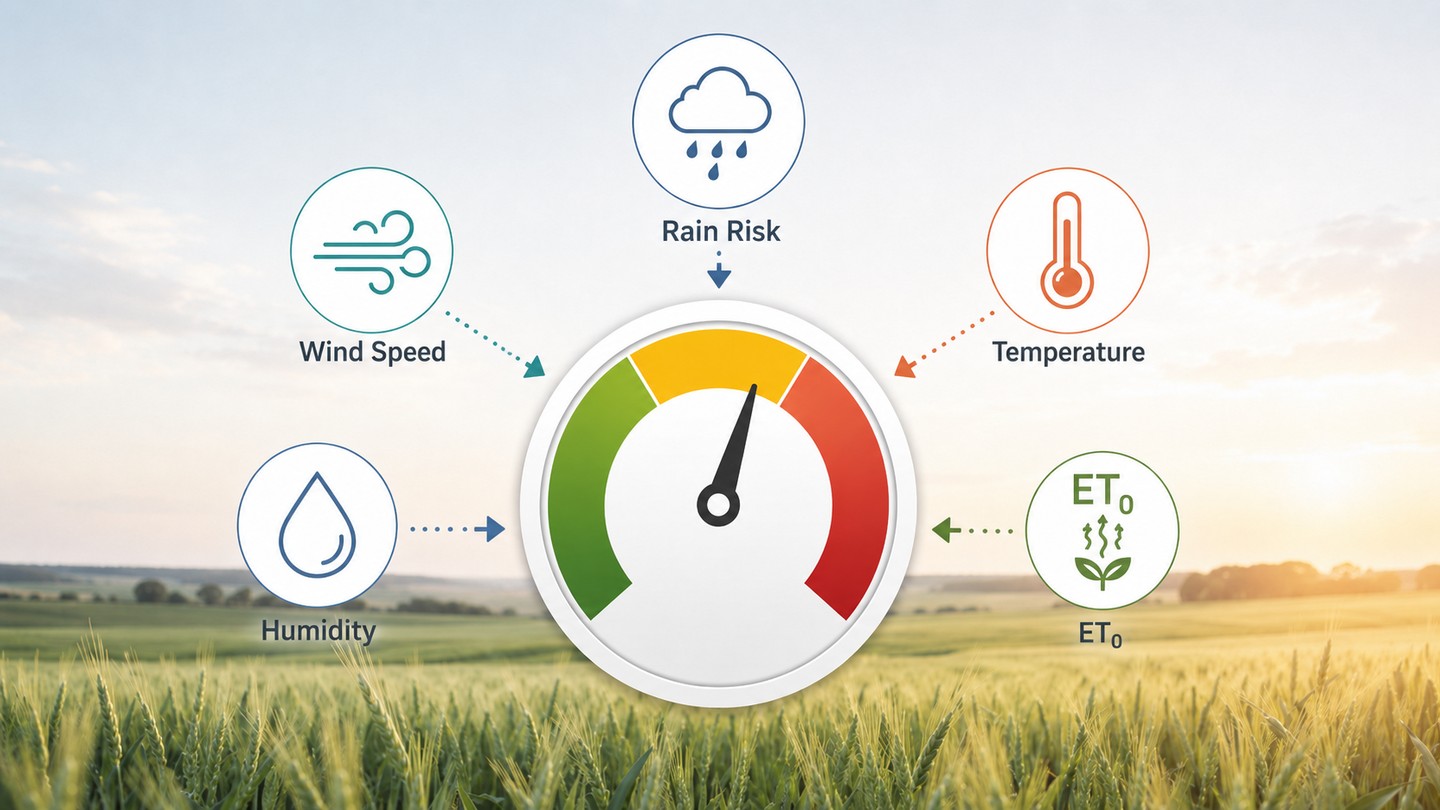
The goal is not only to show raw weather data. The goal is to translate weather conditions into an actionable recommendation.
Instead of looking separately at wind, rainfall, temperature, and humidity, the index combines them into one practical signal:
| Sprayability Level | Meaning | Typical Action |
|---|---|---|
| High | Conditions are generally favorable | Proceed if product label and field conditions allow |
| Moderate | Conditions may be acceptable but require caution | Check wind, rain risk, product label, nozzle, and sensitive areas |
| Low | Conditions are risky or unsuitable | Delay spraying or change the plan |
| Very Low | Spraying is not recommended | Do not spray unless there is a specific justified reason and all rules allow it |
The exact scale can vary by platform. Some systems use a 0–100 score. Others use color categories such as green, yellow, orange, and red.
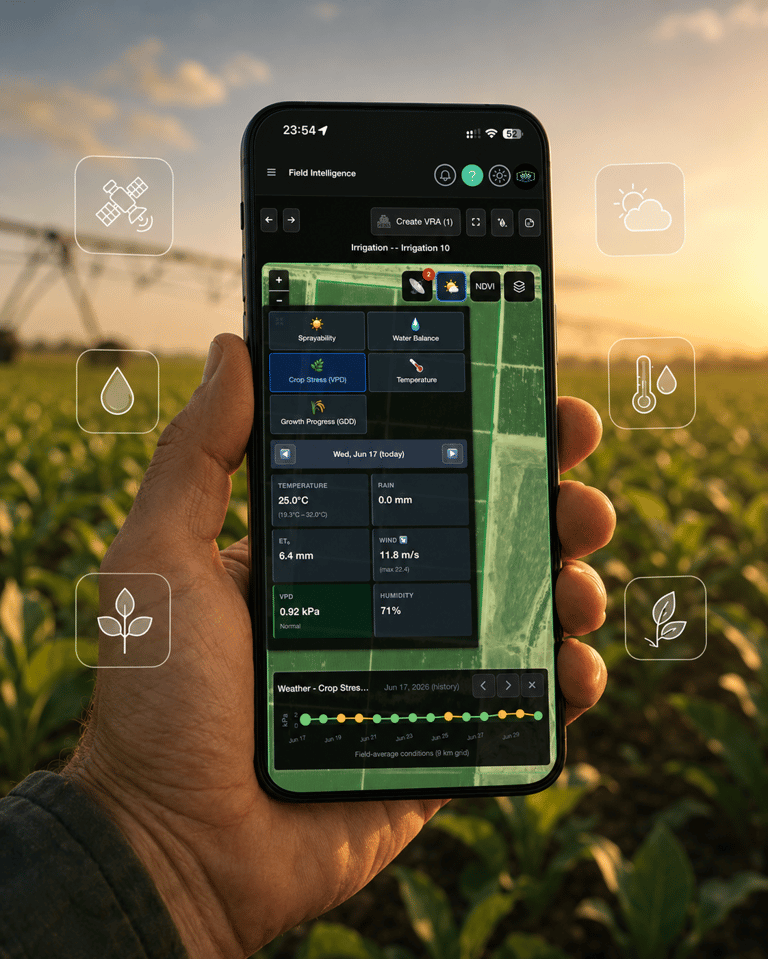
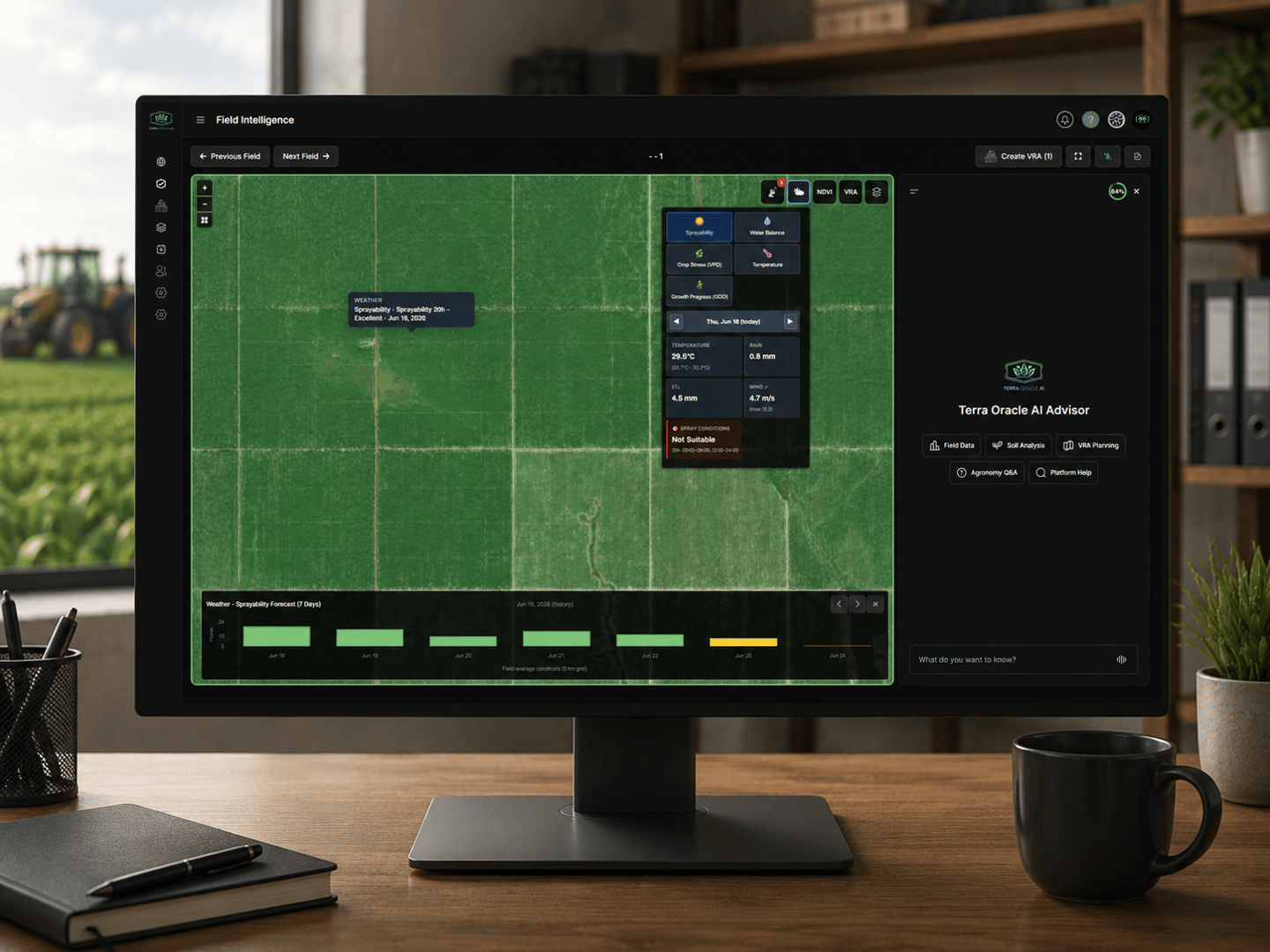
Terra Oracle AI’s AI Advisor continuously analyzes weather conditions and automatically updates the Sprayability Score. The result is presented through a clear Green / Yellow / Red indicator, with transparent explanations based on key parameters including temperature, rainfall, wind speed, and reference evapotranspiration (ETo).
What Weather Factors Affect Sprayability?
A good spraying conditions index should consider several factors together.
1. Wind Speed
Wind is usually the most important factor.
If the wind is too strong, spray droplets can drift away from the target. This reduces application accuracy and increases the risk of off-target damage.
If wind is too calm, that can also be a warning sign, especially during temperature inversion conditions. Under an inversion, small droplets can remain suspended and move unpredictably later.
Practical interpretation:
- Light, steady wind is often better than strong wind or completely still air.
- Strong wind increases drift risk.
- Wind direction matters when sensitive crops, water bodies, roads, houses, or livestock areas are nearby.
2. Rain Risk
Rain after spraying can reduce product effectiveness, especially when a product requires time to dry, absorb, or bind to the target surface.
The sprayability index should consider:
- Probability of rain
- Expected rainfall amount
- Time until rainfall
- Product rainfastness
- Soil and canopy wetness
A spray window may look good at the moment but still be unsuitable if rain is expected soon after application.
3. Temperature
Temperature affects crop condition, product behavior, evaporation, volatilization risk, and worker safety.
High temperatures may increase evaporation and stress the crop. Very low temperatures may reduce biological activity, slow uptake, or make some treatments less effective.
Practical interpretation:
- Avoid spraying during extreme heat.
- Be cautious when crops are already under heat or drought stress.
- Always check product-specific temperature restrictions.
4. Relative Humidity
Humidity affects droplet evaporation and deposition.
Low humidity can cause small droplets to evaporate faster before reaching the crop surface. This can reduce coverage and increase driftable fines.
Higher humidity may improve droplet survival, but very wet conditions can create other issues such as runoff, poor drying, or disease-favorable conditions depending on the operation.
5. Temperature Inversion Risk
A temperature inversion occurs when cooler air is trapped near the ground under warmer air above it. Under these conditions, air movement can be stable and spray droplets may remain suspended instead of dispersing normally.
Inversion risk is often higher:
- Around evening or early morning
- Under clear skies
- With very low wind
- When the ground cools quickly
- In valleys or low-lying areas
A good sprayability index should warn the user when conditions may look calm but are actually risky.
6. Field and Crop Conditions
Weather is not the only factor.
The index may also be interpreted together with:
- Crop growth stage
- Canopy density
- Soil moisture
- Disease pressure
- Pest pressure
- NDVI stress patterns
- Field access conditions
- Previous field operations
This is where an AI Advisor can add value. It can connect sprayability with the actual field situation, not only the weather forecast.
How Is the Sprayability Index Computed?
Different platforms may calculate the index differently, but the logic is usually similar.
A sprayability index starts with weather data and converts each factor into a suitability score.
Example factors:
| Factor | What the Model Checks | Why It Matters |
|---|---|---|
| Wind speed | Is wind within an acceptable operating range? | Controls drift risk |
| Wind direction | Is wind blowing toward sensitive areas? | Reduces off-target risk |
| Rain forecast | Is rain expected during or soon after application? | Reduces wash-off and failure risk |
| Temperature | Is the temperature suitable for product and crop? | Affects evaporation, uptake, crop safety |
| Humidity | Is evaporation risk too high? | Affects droplet survival and coverage |
| Inversion risk | Are air conditions stable and risky? | Reduces drift uncertainty |
| Field access | Is the field likely passable? | Supports operational planning |
A simplified scoring model may look like this:
Sprayability Index =
Wind Suitability
+ Rain Suitability
+ Temperature Suitability
+ Humidity Suitability
+ Inversion Risk Adjustment
+ Field Condition Adjustment
A more advanced model may weigh each factor differently.
For example, wind and rain may receive higher weight than temperature because they can immediately determine whether spraying is practical. Inversion risk may act as a penalty factor. Product type may also change the weighting, because herbicides, fungicides, insecticides, and foliar nutrients do not always have the same ideal conditions.
Example Sprayability Scoring Framework
The following example is not a universal standard. It shows how a platform may translate weather into a practical spraying conditions index.
| Score | Interpretation | Suggested Decision |
|---|---|---|
| 80–100 | Excellent spray window | Good conditions if product label and field situation allow |
| 60–79 | Acceptable spray window | Proceed with caution and verify key risks |
| 40–59 | Marginal conditions | Delay if possible or adjust application setup |
| 20–39 | Poor conditions | Spraying is generally not recommended |
| 0–19 | Very poor conditions | Avoid spraying |
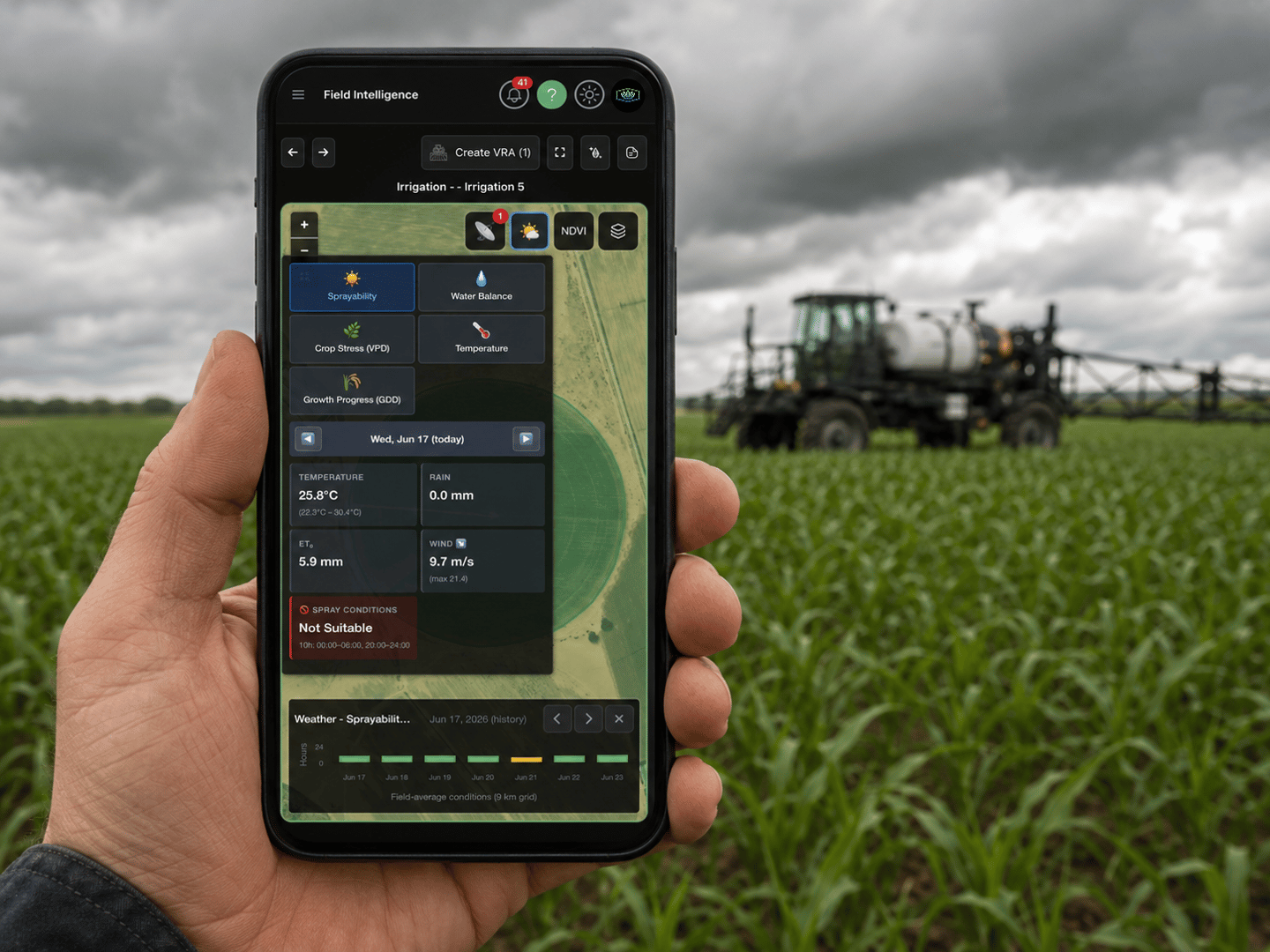
A sprayability index is most useful when it shows not only the score, but also the reason behind the score.
For example:
Sprayability: 42 / 100

Reason:
Wind speed acceptable now, but rain risk increases within 3 hours.
Temperature is suitable.
Humidity is low, increasing evaporation risk.
Recommendation: Delay until tomorrow morning if disease pressure allows.
This explanation is more useful than a simple green or red icon.
How Farmers Should Act on the Sprayability Index
The sprayability index should support operational decisions, not replace them.
If the Index Is High
A high score means conditions are generally suitable.
Recommended action:
- Confirm product label requirements
- Check local regulations
- Confirm wind direction relative to sensitive areas
- Verify nozzle, pressure, boom height, and droplet size
- Confirm field access and crop stage
- Proceed if all conditions are acceptable
If the Index Is Moderate
A moderate score means the window may be usable, but not perfect.
Recommended action:
- Look at the limiting factor
- Consider changing nozzle or droplet size
- Reduce boom height if appropriate
- Avoid sensitive borders
- Prioritize fields with higher pest or disease pressure
- Consider waiting for a better window if risk is not urgent
If the Index Is Low
A low score means the operation may be risky.
Recommended action:
- Delay spraying if possible
- Re-check the forecast
- Look for the next better spray window
- Consider whether the agronomic risk of waiting is higher than the application risk
- Document the reason for postponement
If the Index Is Very Low
A very low score usually means spraying should not proceed.
Possible reasons:
- Strong wind
- Rain expected soon
- High temperature
- Very low humidity
- Inversion risk
- Unsafe direction toward sensitive areas
- Poor field access
The correct decision is usually to wait.
Practical Example: Choosing Between Two Spray Windows
Assume a wheat field has early disease pressure and the farmer wants to apply fungicide this week.
Option A: Tuesday Afternoon
| Factor | Condition |
|---|---|
| Wind | Increasing |
| Rain risk | Low |
| Temperature | High |
| Humidity | Low |
| Inversion risk | Low |
| Sprayability | Moderate to low |
The main issue is evaporation and drift risk under warm, dry, windy conditions.
Option B: Thursday Morning
| Factor | Condition |
|---|---|
| Wind | Light and steady |
| Rain risk | Low for 8 hours |
| Temperature | Moderate |
| Humidity | Suitable |
| Inversion risk | Low after sunrise |
| Sprayability | High |
Option B is the better spray window, assuming disease pressure does not require immediate action.
This is exactly the type of decision where a sprayability index is useful. It helps the user compare windows, not just inspect current weather.
Sprayability Index and Disease Pressure
Sprayability should not be evaluated in isolation.
For fungicide timing, the best spray window must be balanced against disease pressure. If disease risk is rising quickly, waiting too long can reduce control. If pressure is low, waiting for better spray conditions may improve application quality and reduce waste.
A strong decision-support system should combine:
- Sprayability index
- Disease pressure
- Crop stage
- Leaf wetness
- Humidity
- Rainfall history
- Forecasted infection risk
- NDVI stress patterns
- Field scouting observations
The question is not only:
“Can I spray now?”
The better question is:
“Is this the best practical spray window, given the agronomic risk in this field?”
Sprayability Index and AI Advisor
The Terra Oracle AI Advisor uses weather data and agronomic indices to help identify safe and effective spray windows.
The role of AI is not just to display wind and rain. It is to connect spraying conditions with the field context.
For example, a farmer might ask:
“Any good spray windows this week?”
A useful AI Advisor should evaluate:
- Wind forecast
- Rain risk
- Temperature
- Humidity
- Field condition
- Crop stage
- Disease or pest risk
- Previous operations
- NDVI stress signals
- Urgency of intervention
The answer should be practical:
High wind through Wednesday.
Rain risk midweek.
Best spray window: Thursday morning.
Low wind, suitable temperature, and no rain expected for several hours.
This makes the sprayability index more actionable. It turns weather data into an operational decision.
Learn more: Terra Oracle AI Advisor
What the Sprayability Index Should Not Do
The sprayability index should not be used as a legal or label override.
It should not replace:
- Product label instructions
- Buffer zone requirements
- Local pesticide regulations
- Operator training
- Professional agronomic judgment
- On-site weather verification
- Safe handling requirements
The index is a decision-support tool. It helps identify better timing, but the operator remains responsible for safe and compliant application.
Common Mistakes When Using Spray Windows
Mistake 1: Looking Only at Wind Speed
Wind speed matters, but it is not the only factor. Wind direction, inversion risk, rain, humidity, and temperature can be equally important.
Mistake 2: Ignoring Rainfastness
Some products need a specific rain-free period after application. A good spray window must consider whether rainfall is expected soon after spraying.
Mistake 3: Spraying in Very Calm Conditions Without Checking Inversion Risk
Very low wind may look safe, but it can sometimes indicate stable air and inversion risk. Calm conditions are not always ideal.
Mistake 4: Using the Same Threshold for Every Product
Different products have different requirements. Herbicides, fungicides, insecticides, desiccants, and foliar nutrients may require different timing logic.
Mistake 5: Treating the Index as a Yes/No Answer
The index should explain the limiting factor. A score of 55 caused by rain risk is different from a score of 55 caused by high wind or low humidity.
How to Use the Sprayability Index in Daily Farm Management
A practical workflow:
flowchart LR
S0["Check Field Need"]
S0 --> S1["Review Sprayability Index"]
S1 --> S2["Identify Limiting Factor"]
S2 --> S3["Compare Spray Windows"]
S3 --> S4["Check Product Label and Regulations"]
S4 --> S5["Adjust Setup if Needed"]
S5 --> S6["Spray or Delay"]
This workflow is simple, but it prevents many poor timing decisions.
FAQ
What is the sprayability index?
The sprayability index is a weather-based agronomic indicator that estimates whether conditions are suitable for spraying. It usually considers wind, rain, temperature, humidity, and sometimes inversion risk.
What is a spray window?
A spray window is a period when weather and field conditions are suitable for spraying. A good spray window has acceptable wind, low rain risk, suitable temperature, suitable humidity, and manageable drift risk.
What is a spraying conditions index?
A spraying conditions index is another name for a sprayability index. It translates weather factors into a practical score or category that helps farmers decide when to spray.
Does a high sprayability score mean I can always spray?
No. A high score means weather conditions are generally favorable, but the operator must still follow the product label, local regulations, buffer rules, and on-site safety requirements.
Why can very low wind be risky?
Very low wind can sometimes be associated with temperature inversion conditions. During an inversion, spray droplets may remain suspended and move unpredictably, increasing off-target risk.
Why does humidity matter for spraying?
Low humidity can increase droplet evaporation, especially for smaller droplets. This can reduce coverage and increase the risk that spray does not reach the target effectively.
How does AI improve spray timing?
AI can combine the sprayability index with crop stage, disease pressure, NDVI stress, weather forecast, and field history. This helps identify not only whether spraying is possible, but whether it is the best decision for that field.
Conclusion
The sprayability index helps farmers turn weather data into better spraying decisions.
Instead of checking wind, rain, temperature, and humidity separately, the index summarizes whether the current or forecasted conditions are suitable for spraying. The best systems also explain why a window is good or risky.
Used correctly, the sprayability index can help reduce drift risk, improve application quality, avoid wasted inputs, and support better crop protection timing.
But it should always be used with product labels, local regulations, field judgment, and safe operating practices.
In a modern precision agriculture workflow, the sprayability index becomes even more powerful when connected to AI-based decision support. By combining weather, crop condition, field history, NDVI, disease pressure, and operational data, Terra Oracle AI Advisor helps farmers move from raw weather information to clear, field-specific spray timing decisions.
Learn more: