Talk to Your Fields: The AI Farming Assistant
Discover how an AI farming assistant turns soil, weather, NDVI, and field data into multilingual, explainable agronomic advice through text and voice.
Quick Answer
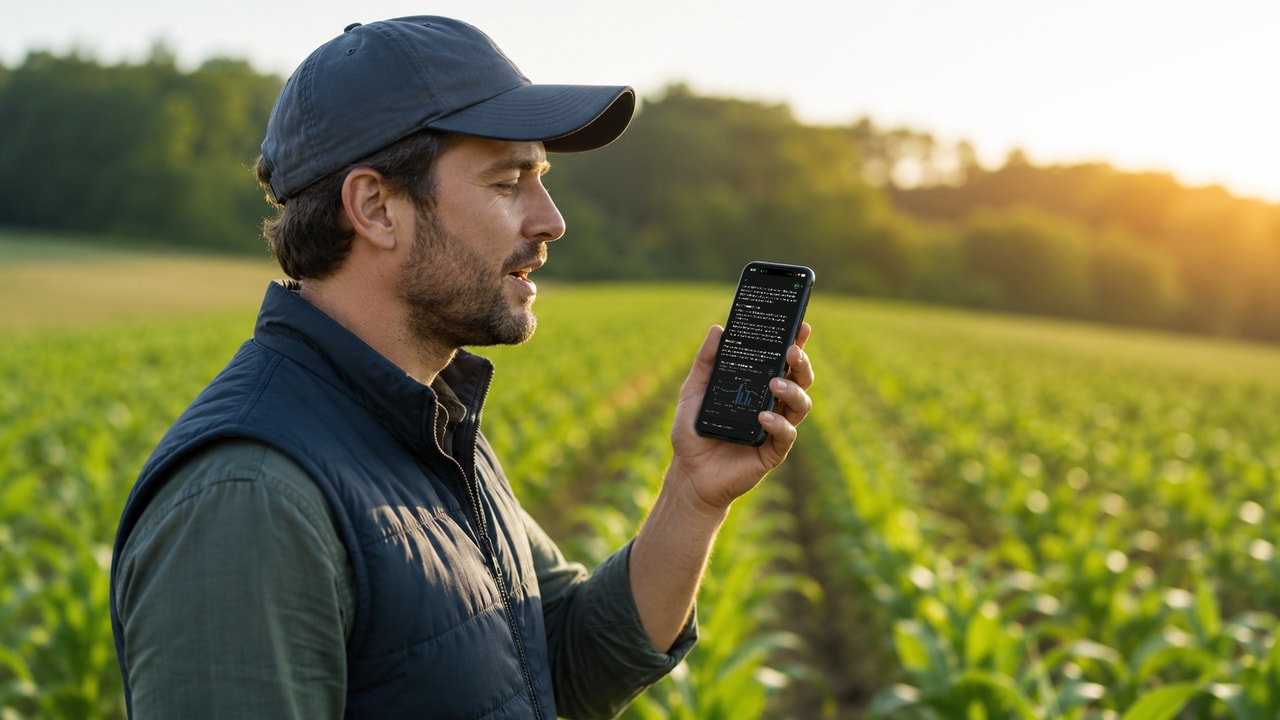
An AI farming assistant is a conversational agronomy tool that allows farmers, agronomists, and dealers to ask field-specific questions in natural language and receive explainable recommendations based on soil data, satellite imagery, weather, crop stage, field history, and operational context.
Unlike a generic agronomy chatbot, a true AI farming assistant should not only answer general questions. It should understand the specific field, explain why a recommendation was made, identify the limiting factors behind crop stress, and help convert the decision into an action such as scouting, irrigation timing, fertilizer planning, spray window selection, or variable-rate application.
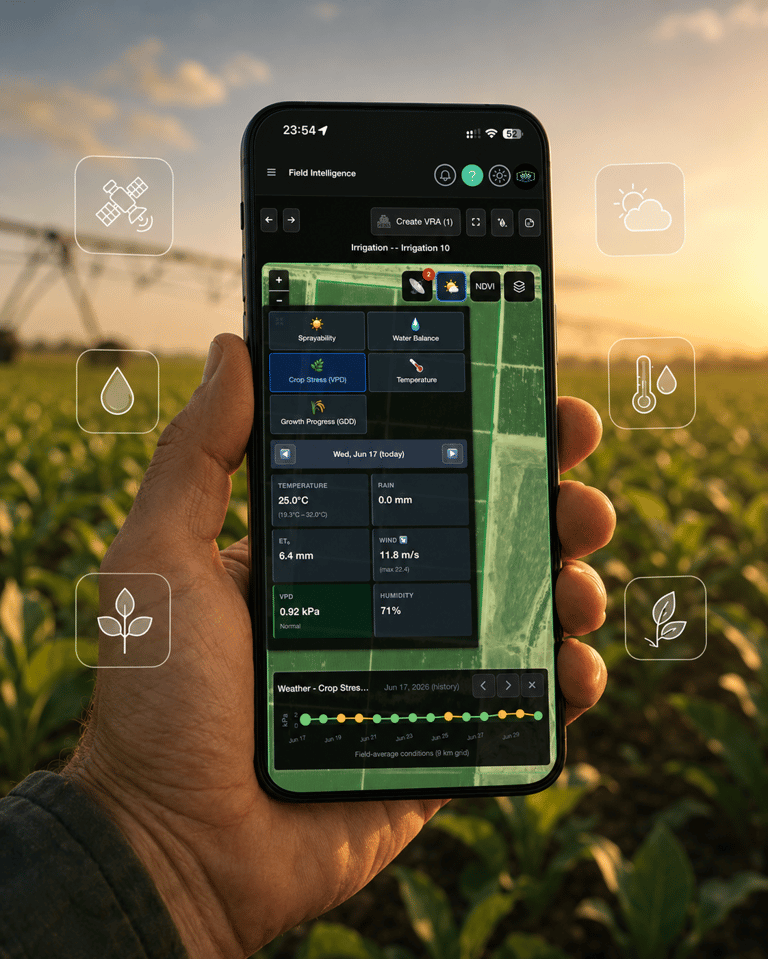
The Terra Oracle AI Advisor is designed for this purpose: multilingual text and voice interaction, field-specific reasoning, explainable recommendations, proactive alerts, and executable outputs connected to modern precision agriculture workflows.
What is an AI farming assistant?
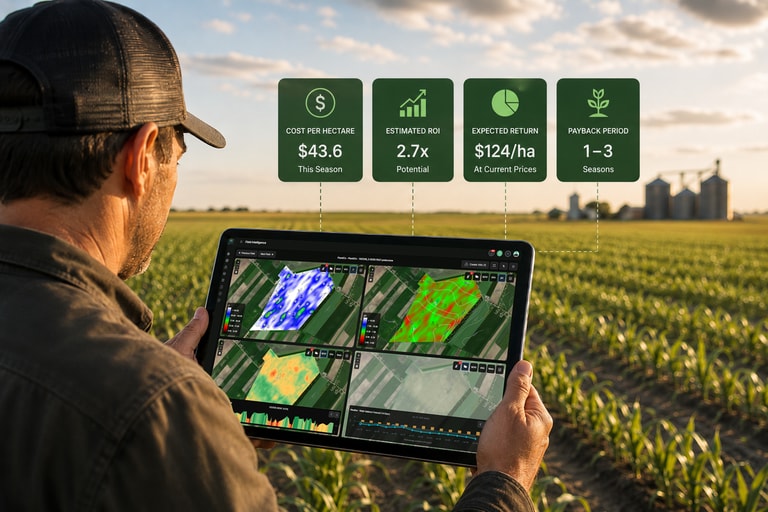
An AI farming assistant is a digital advisor that lets farmers “talk” to their fields.
Instead of opening multiple dashboards, comparing maps, checking weather forecasts, reading soil test reports, and manually interpreting crop stress, the user can ask a direct question:
“Why is the northwest zone underperforming this week?”
A useful AI farming assistant should answer with context:
“The northwest zone has lower potassium, reduced NDVI over the past five days, and recent high VPD conditions. The likely issue is reduced nutrient uptake under moisture stress. Scout the area first, then consider a targeted potassium correction if the crop stage and soil moisture support application.”
This is the shift from data viewing to conversational agronomy.
Farmers already have more data than ever: soil analysis, field boundaries, yield maps, satellite NDVI, weather forecasts, machine data, scouting observations, irrigation records, and input costs. The problem is not only access to data. The problem is translating fragmented data into a clear answer:
- What is happening?
- Why is it happening?
- How serious is it?
- What should I do next?
- What is the agronomic and economic logic behind the recommendation?
That is where an AI farming assistant becomes valuable.
Why agriculture needs conversation, not just dashboards
Most precision agriculture platforms were built around maps, charts, layers, and reports. These are useful, but they still require interpretation.
A farmer may see:
- a low NDVI zone,
- a potassium variability map,
- a rainfall forecast,
- a soil moisture trend,
- a sprayability warning,
- a variable-rate prescription,
- and a yield response estimate.
Each layer tells part of the story. The real agronomic decision depends on how the layers interact.
A conversational AI farming assistant creates a new interface between the user and the data. The user does not need to know which layer to open first. The assistant can help connect the evidence and present the decision in plain language.
For example:
Farmer: “Can I spray field 42 tomorrow morning?”
AI farming assistant: “Tomorrow morning looks marginal. Wind speed is expected to rise after 10:30, and humidity is high enough to increase drift and drying-time concerns. The best spray window is 06:30–09:30. Check the product label and local regulations before application.”
This type of answer is more useful than a weather table because it connects the forecast to the operational decision.
Agronomy chatbot vs AI farming assistant
The terms agronomy chatbot, AI farming assistant, and voice farm assistant are often used together, but they are not the same.
A basic agronomy chatbot answers general agricultural questions. It may explain what nitrogen does, what VPD means, or how to identify a common pest.
An AI farming assistant should go further. It should use field-specific data and agronomic reasoning.
| Capability | Basic agronomy chatbot | AI farming assistant |
|---|---|---|
| Answers general farming questions | Yes | Yes |
| Understands a specific field boundary | Usually no | Yes |
| Uses soil, satellite, weather, and operation data | Limited | Yes |
| Explains the reason behind the recommendation | Sometimes | Required |
| Supports multilingual text and voice | Sometimes | Yes |
| Creates alerts from changing field conditions | Usually no | Yes |
| Supports execution through prescriptions or integrations | Usually no | Yes |
| Helps agronomists and dealers scale advisory work | Limited | Yes |
The difference is important. Agriculture is local, spatial, seasonal, and time-sensitive. A generic answer is rarely enough.
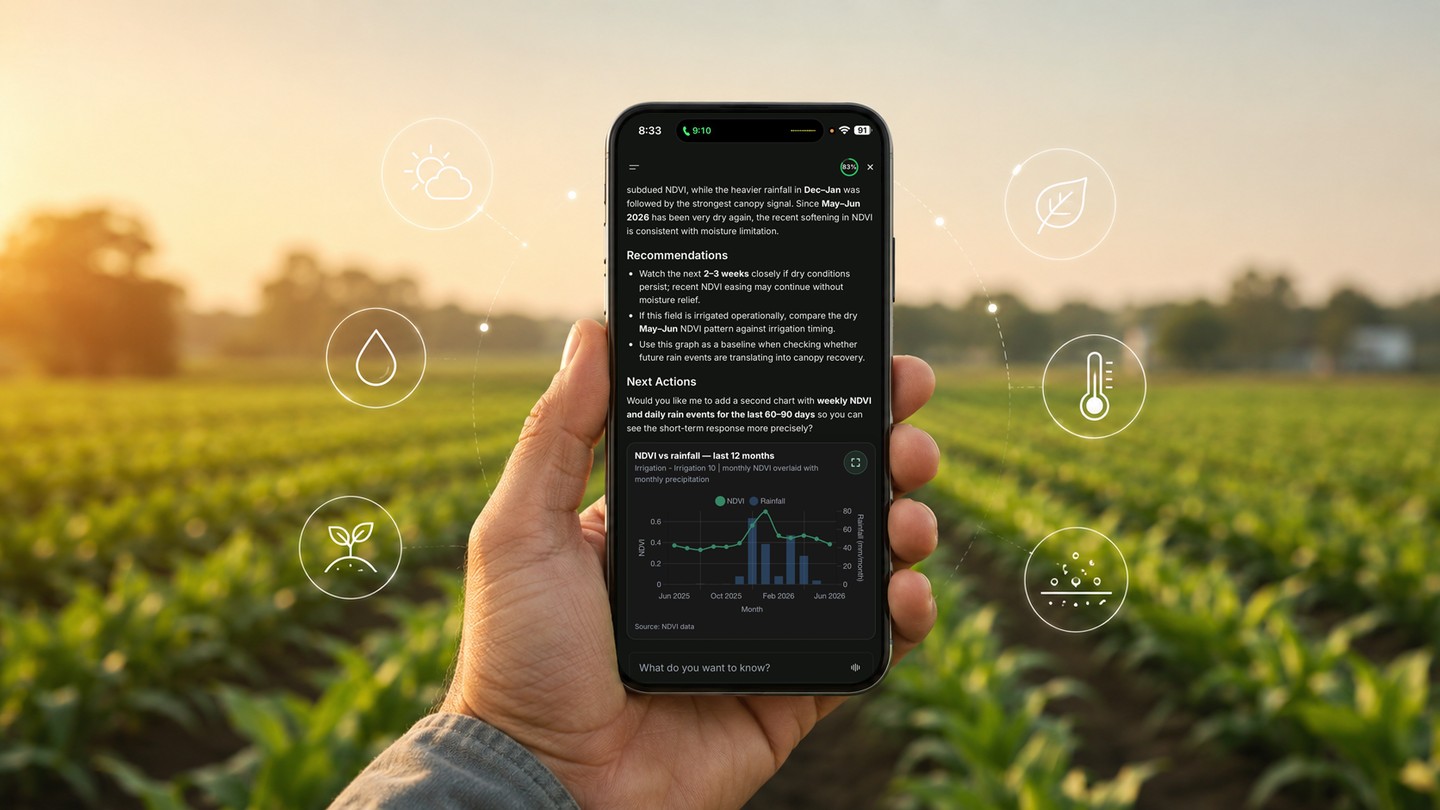
How a multilingual conversational agronomy advisor works
A field-specific AI farming assistant can be understood as five connected layers.
1. Field data layer
The assistant starts with the field context. This may include:
- field boundary,
- crop type,
- soil analysis, with optional high-resolution soil maps,
- nutrient and pH variability,
- satellite NDVI and vegetation trends,
- weather history and forecast,
- topography,
- irrigation data,
- machinery operations,
- scouting observations,
- input costs and economic assumptions.
The better the field data, the more useful the assistant becomes.
2. Agronomic reasoning layer
The assistant should not simply repeat data. It should reason across data sources.
For example, a low NDVI zone could be caused by many different factors:
- nutrient deficiency,
- pH constraint,
- compaction,
- waterlogging,
- drought stress,
- disease pressure,
- poor emergence,
- herbicide injury,
- poor drainage,
- salinity,
- or a combination of factors.
A conversational agronomy system should compare the evidence before recommending action.
3. Natural language layer
The user asks questions in normal language:
- “Why is this zone yellow?”
- “Where should I scout first?”
- “Is this field ready for nitrogen?”
- “Should I irrigate before the heat wave?”
- “Can I spray tomorrow afternoon?”
- “Which field has the highest ROI opportunity this week?”
The assistant converts these questions into structured agronomic tasks.
4. Multilingual text and voice layer
A multilingual advisor makes the platform more accessible to different users: farmers, operators, agronomists, dealers, and enterprise teams across regions.
Voice is especially important in agriculture because many decisions happen outside the office. A farmer may be in a field, in a pickup, on a tractor, or walking with an agronomist. A voice farm assistant reduces the need to search through menus while working.
5. Explainable recommendation layer
The final answer should explain:
- the recommendation,
- the evidence behind it,
- the limiting factor,
- the confidence level or uncertainty,
- the next action,
- and any safety, label, or regulatory limitation.
This is the difference between a black-box AI answer and a decision farmers can trust.
Example dialogue 1: Understanding crop stress
Farmer: “Why is the northwest part of this field weaker than the rest?”
AI farming assistant: “The northwest zone has shown lower NDVI for the past five days. Soil data also shows lower potassium and slightly lower pH compared with the central zone. Recent high VPD conditions may have reduced nutrient uptake. The most likely explanation is combined potassium limitation and moisture stress.”
Farmer: “What should I do?”
AI farming assistant: “Scout the northwest zone first. Check crop rooting, leaf symptoms, and soil moisture. If symptoms match potassium stress and application conditions are suitable, consider a targeted correction rather than treating the whole field uniformly.”
Why this matters: The assistant does not stop at “NDVI is lower.” It connects crop performance, soil variability, and weather stress into an agronomic explanation.
Example dialogue 2: Spray timing
Farmer: “Can I spray field 18 tomorrow?”
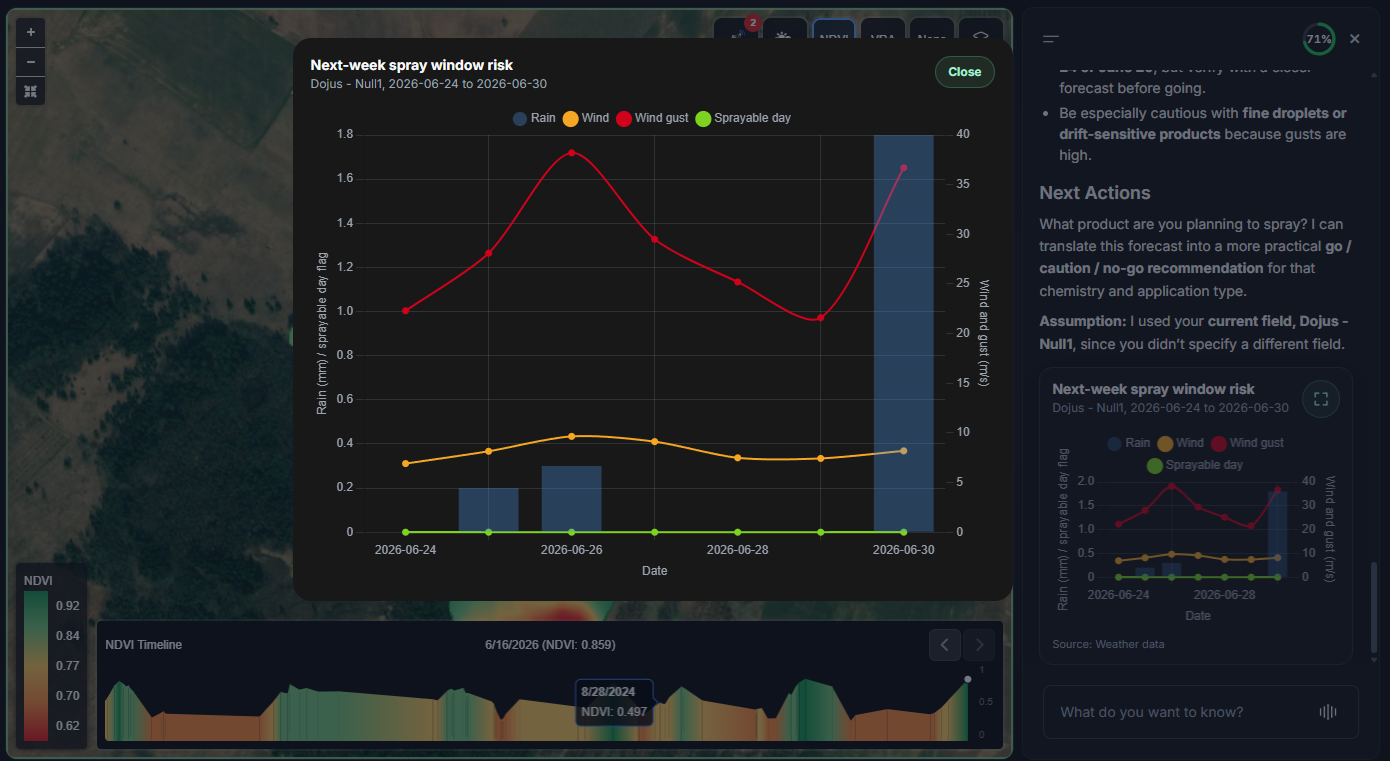
AI farming assistant: “The best window appears to be early morning. Wind is forecast to increase later in the day, and rainfall risk rises in the evening. If the product label allows the planned application under the expected temperature, humidity, and wind conditions, the preferred window is 06:30–09:30.”
Farmer: “Can you show me in a graph next week spray windows, and overlap them with rain and wind forecast.”
Farmer: “What is the limiting factor?”
AI farming assistant: “Wind is the main limiting factor. Rain risk becomes relevant later in the day. Temperature is acceptable during the early window.”
Why this matters: A good voice farm assistant should not only say “yes” or “no.” It should explain the limiting factor so the farmer understands the operational risk.
Example dialogue 3: Irrigation and VPD
Farmer: “Should I irrigate before the heat wave?”
AI farming assistant: “Field water balance is approaching the irrigation threshold, and VPD is expected to increase over the next two days. If water is available, irrigation before peak stress may reduce crop stress. Prioritize the sandier zones and fields with lower soil water-holding capacity.”
Farmer: “Which fields should I prioritize?”
AI farming assistant: “I prioritized by projected water deficit volume so the ranking reflects both crop water demand and field size. That makes Irrigation 3, 2, and 7 the best places to focus first if water, pumping time, or labor will be constrained next week.”
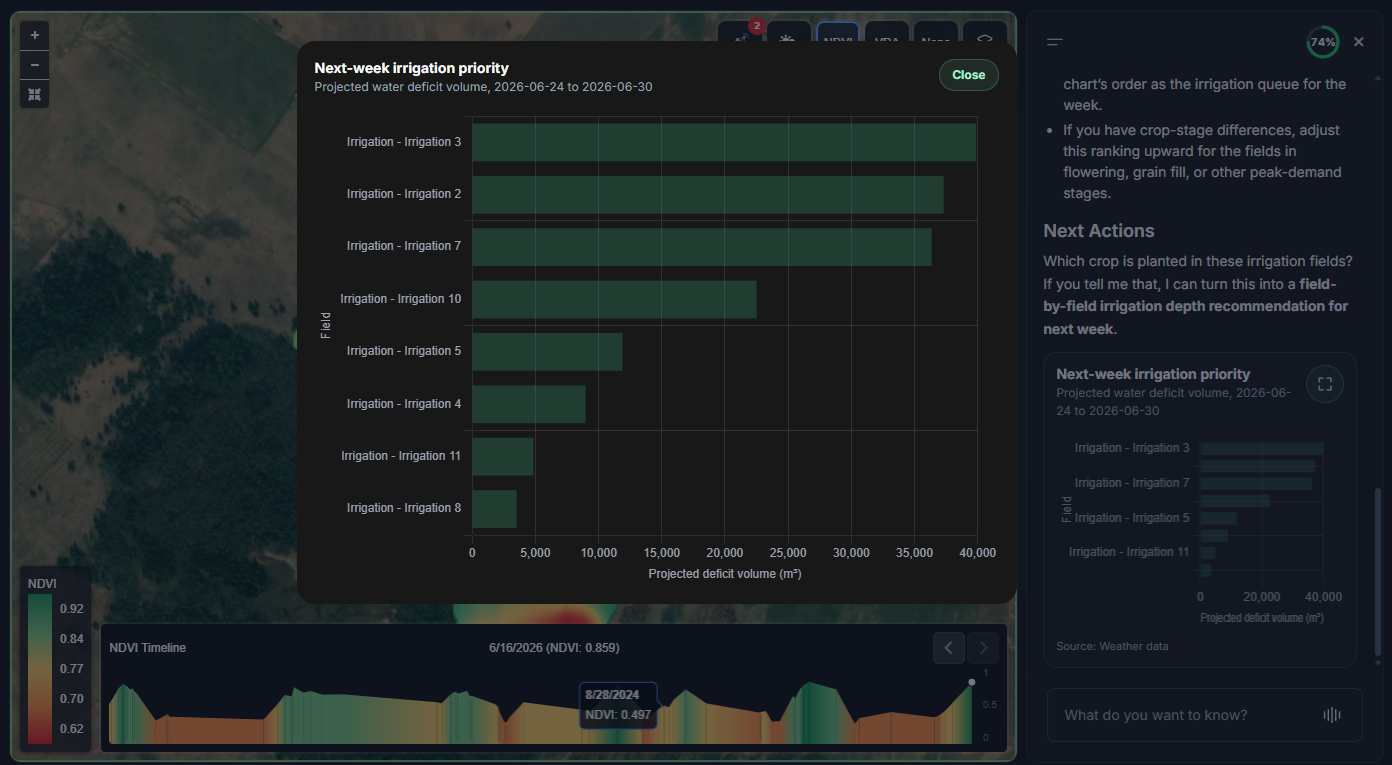
Why this matters: The AI assistant helps prioritize limited water and labor by combining weather, soil, and crop response.
Example dialogue 4: Variable-rate fertilizer
Farmer: “Is variable-rate potassium worth it in this field?”
AI farming assistant: “The field has strong potassium variability. A uniform rate would over-apply in the high-K zones and under-apply in the low-K zones. Variable-rate application may be justified if the expected yield response in the deficient zones exceeds the added mapping and application cost.”
Farmer: “Show me exactly where in the field I have low potassium zones and overlap it with NDVI to validate that it is limiting growth.”
Ground-truthing AI recommendations against soil and satellite layers is an important part of trustworthy conversational agronomy.
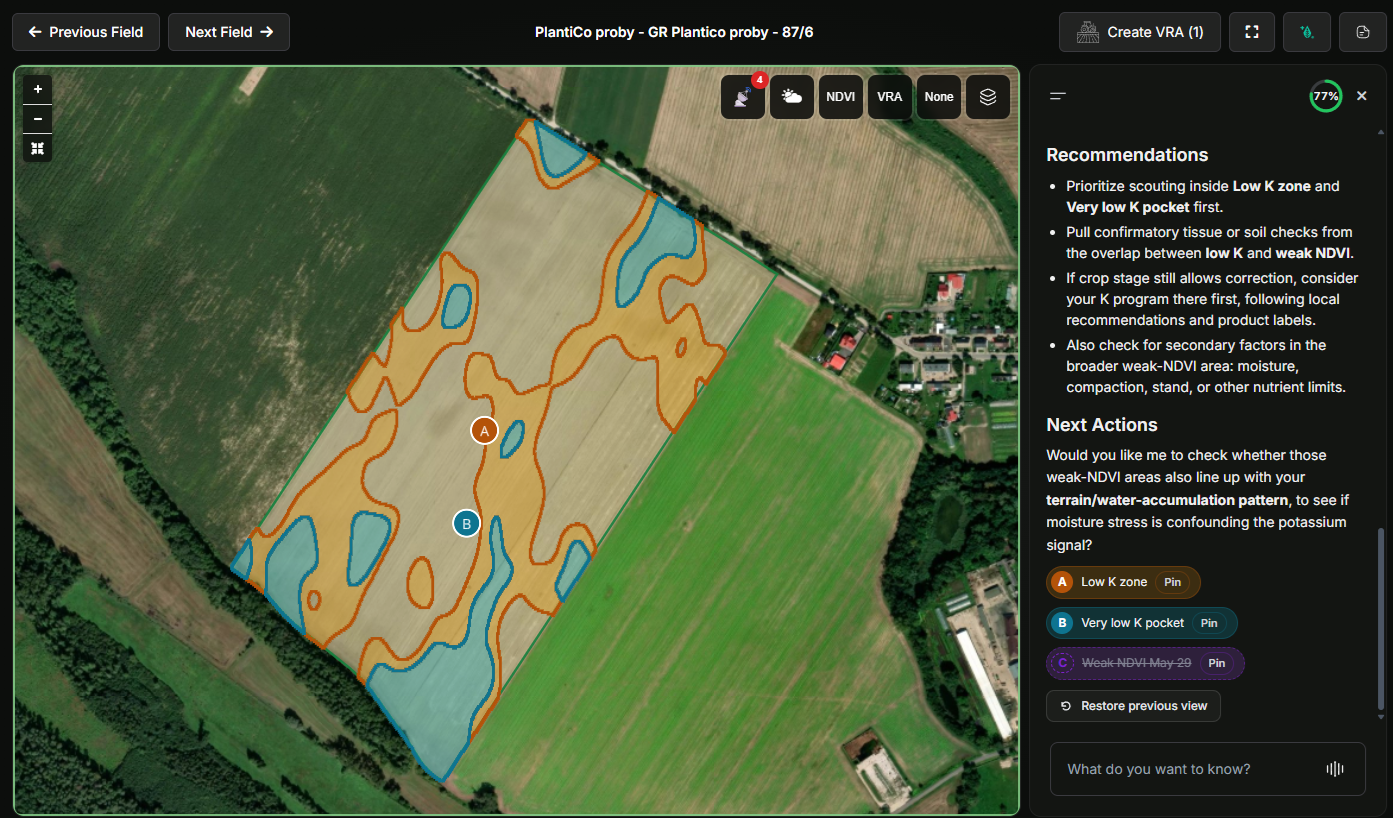
Farmer: “Can you create a prescription?”
AI farming assistant: “Yes. I can prepare a zone-based potassium prescription using the calibrated soil map, target rates, and spreader constraints. Review the rates with your agronomist before execution.”
Why this matters: The assistant connects agronomy with economics and execution. The decision is not simply “apply more fertilizer.” The decision is where, how much, and whether the expected response justifies the cost.
Why explainability matters in AI agronomy
Agronomic decisions are high-consequence decisions. A wrong recommendation can waste fertilizer, increase disease risk, miss a spray window, reduce yield, or create compliance problems.
That is why explainability matters.
An AI farming assistant should not say:
“Apply potassium.”
It should say:
“Apply potassium in the northwest zone because the soil map shows lower K, NDVI has declined relative to the rest of the field, and recent weather increased stress risk. The recommendation is zone-specific; the rest of the field does not show the same evidence.”
Explainability helps farmers and agronomists evaluate whether the answer makes sense. It also supports collaboration. A dealer agronomist, farm manager, and machine operator can all understand the same recommendation.
Scientific work on explainable AI in agriculture highlights the same principle: AI is more useful when users can understand the factors behind predictions and recommendations, especially in field decisions involving irrigation, pest control, crop yield, and resource optimization. [1]
The role of scientific grounding
Conversational AI in agriculture is promising, but it must be grounded.
Large language models can produce fluent answers. Fluency is not the same as agronomic correctness.
For agricultural use, a responsible AI farming assistant should be connected to:
- verified field data,
- calibrated soil information,
- trusted agronomic models,
- local weather data,
- scientific and technical references,
- product label constraints,
- regional practices,
- and human agronomic review where required.
Research on agricultural question-answering systems and farmer-facing chatbots shows strong potential for natural-language agricultural support, especially when systems use curated knowledge bases, retrieval methods, local language support, and expert validation. [2][3][4]
This is why Terra Oracle AI focuses on explainable, field-specific agronomic intelligence rather than a generic chatbot experience.
Why voice matters in the field
Voice interaction is not just a convenience feature. In agriculture, it is often the most natural way to work.
Farmers are rarely sitting at a desk when important decisions are made. They are walking fields, driving between plots, checking crop symptoms, operating machinery, meeting an agronomist, or reviewing conditions during a narrow spray or irrigation window. In many of these situations, their hands are busy and typing is not practical.
A voice farm assistant allows the user to ask questions at the exact moment of decision:
- “What am I looking at in this zone?”
- “Why is this part of the field weaker?”
- “Where should I scout first?”
- “What changed since yesterday?”
- “Is the spray window still open?”
- “Which field is most urgent today?”
Voice also makes the interaction more responsive. Instead of asking one question, reading a static answer, and then searching for the next layer manually, the farmer can challenge the result and continue the discussion:
- “Are you sure this is potassium and not water stress?”
- “What evidence supports that?”
- “Show me the limiting factor.”
- “What happens if I delay the application by two days?”
- “Is this recommendation still valid if rain comes tomorrow?”
This turns the AI farming assistant from a simple question-and-answer tool into a real agronomic conversation.
Language is another important factor. Many farmers and field operators are not fully comfortable discussing technical agronomy in English. Even when they understand English, it is often easier and faster to discuss soil, crop stress, fertilizer, irrigation, spray timing, and field operations in their native language.
A multilingual voice farm assistant reduces this barrier. It allows farmers, agronomists, dealers, and operators to discuss complex agronomic decisions using familiar terms, local language, and practical field context. This is especially important when the goal is not only to show data, but to explain it clearly enough for action.
How Terra Oracle AI’s AI Advisor fits this shift
The Terra Oracle AI Advisor is built around the idea that farmers should be able to interact with agronomic intelligence directly.
The assistant is designed to support:
- natural language questions,
- multilingual text and voice interaction,
- explainable recommendations,
- field alerts,
- soil-driven decision support,
- NDVI and weather interpretation,
- variable-rate planning,
- and execution workflows through prescription outputs and integrations.
This matters because modern farms do not need another isolated data layer. They need an assistant that can connect the layers.
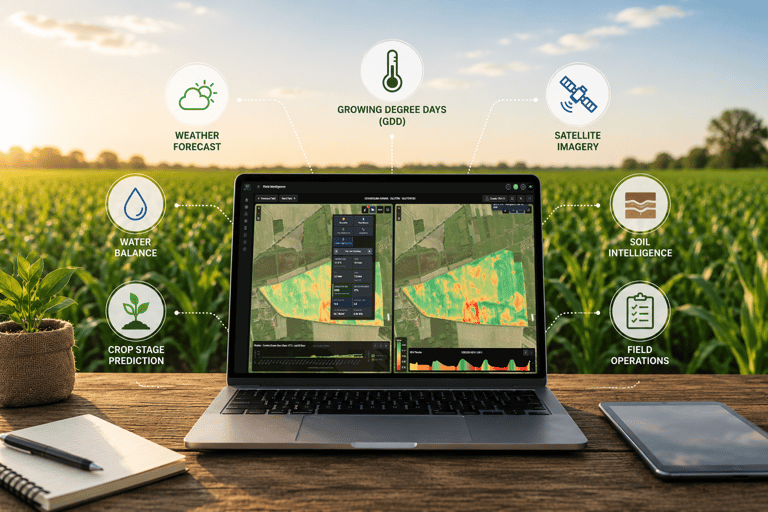
Terra Oracle AI combines soil intelligence, satellite monitoring, weather, operations, and economic context into a field-specific reasoning system. The result is a practical conversational agronomy workflow:
- The field is monitored.
- The system identifies a change or risk.
- The farmer asks a question.
- The AI explains the likely cause.
- The recommendation is tied to evidence.
- The user can act through scouting, timing, VRA, or operational planning.
This is the future of AI in agriculture: not replacing agronomists, but giving farmers, agronomists, and dealers a faster way to interpret field complexity.
Where an AI farming assistant creates value
1. Faster field interpretation
Instead of manually comparing soil maps, NDVI layers, weather forecasts, field history, and scouting notes, the user can ask what changed and why. The assistant helps turn complex field data into a clear agronomic explanation.
2. Better scouting priorities
The assistant can rank fields or zones based on risk signals, helping farmers and agronomists focus attention where it matters most.
3. More explainable recommendations
Every recommendation should include the agronomic logic behind it. This helps the user understand the limiting factor, the evidence, and the reason for the suggested action.
4. Improved timing decisions
Weather-sensitive tasks such as spraying, irrigation, fertilizer application, and scouting can be evaluated in context, helping the user act within the best operational window.
5. Scalable agronomic decision support
One of the biggest advantages of an AI farming assistant is scale. Large farms, dealers, and service providers often manage thousands of hectares, many fields, multiple crops, and constantly changing weather and operational conditions.
AI can process large volumes of soil, satellite, weather, crop, and machinery data much faster than manual review. This allows agronomic insights to be generated across many fields at once, without relying only on the limited availability of expert agronomists.
This does not replace professional agronomy. It helps scale it. The AI assistant can identify risks, prioritize fields, explain likely causes, and prepare recommendations so that agronomists and farm managers can focus their time on the highest-value decisions.
6. Stronger dealer advisory services
Dealers and agronomy service providers can support more hectares with a consistent decision workflow, while still keeping expert agronomists involved in review, validation, and customer relationships.
7. Better variable-rate execution
The assistant can help convert soil and crop variability into actionable prescriptions, supporting more precise fertilizer, lime, irrigation, and crop-management decisions.
8. Multilingual collaboration
Farm teams, operators, dealers, and agronomists can interact with the same field intelligence in the language they understand best, making technical agronomic recommendations easier to discuss and execute.
What an AI farming assistant should not do
A responsible AI farming assistant should not replace product labels, local regulations, certified agronomic advice, or professional judgment.
It should not claim certainty when field evidence is incomplete.
It should not recommend pesticide, fertilizer, irrigation, or machinery actions without considering:
- crop stage,
- product label,
- local regulation,
- weather conditions,
- application equipment,
- field constraints,
- environmental risk,
- and economic justification.
The best AI farming assistant is not a black-box decision maker. It is a transparent decision-support layer.
The future: from farm dashboards to farm dialogue
The next generation of digital agriculture will not be defined only by better maps.
It will be defined by better conversations with field data.
Farmers will increasingly expect to ask:
- “What changed?”
- “Why did it change?”
- “What should I do?”
- “What happens if I delay?”
- “Which field should I handle first?”
- “Can this become a prescription map?”
That is the promise of conversational agronomy.
The AI farming assistant becomes the bridge between complex agricultural data and practical action.
With Terra Oracle AI, the goal is simple: make field intelligence easier to understand, easier to explain, and easier to execute.
FAQ
What is an AI farming assistant?
An AI farming assistant is a conversational digital advisor that helps farmers and agronomists ask questions about their fields and receive field-specific recommendations based on soil, satellite, weather, crop, and operational data.
How is an AI farming assistant different from an agronomy chatbot?
An agronomy chatbot usually answers general farming questions. An AI farming assistant should use field-specific data, explain the reasoning behind recommendations, and support practical actions such as scouting, irrigation timing, spray planning, and variable-rate application.
Can farmers use a voice farm assistant in the field?
Yes. A voice farm assistant allows users to ask questions while walking fields, driving between farms, or working in operational conditions where typing is inconvenient.
Why is explainability important in AI agronomy?
Explainability helps farmers understand why the AI made a recommendation. This is critical because agronomic decisions affect input cost, crop performance, compliance, and yield.
Does an AI farming assistant replace an agronomist?
No. A responsible AI farming assistant supports agronomists and farmers by organizing data, identifying risks, explaining patterns, and accelerating decision-making. Final decisions should still consider professional judgment, local conditions, product labels, and regulations.
What data does Terra Oracle AI use for field-specific recommendations?
Terra Oracle AI connects field boundaries, soil intelligence, satellite NDVI, weather, terrain, operations, and economic context into a field-specific reasoning workflow.
Can the AI Advisor help create variable-rate prescriptions?
Yes. When suitable field data is available, the AI Advisor can help interpret variability and support variable-rate planning and prescription workflows.
Conclusion
Conversational agronomy turns fragmented field data into explainable decisions farmers can act on — through text, voice, and workflows tied to soil, satellite, weather, and operations.
Learn more:
- AI Advisor
- AI Soil Scanner
- Technology
- How Terra Oracle AI Turns Field Data Into Better Decisions
- How Gamma-Based Soil Scanning Works in Modern Agriculture
- The Economics of Variable-Rate Fertilizer
- The Sprayability Index, Explained
- Vapor Pressure Deficit (VPD) in the Field
References
- Rajbongshi, A., et al. (2026). Leveraging explainable AI for sustainable agriculture: a comprehensive review of recent advances . Artificial Intelligence Review, 59, 105.
- Jain, M., et al. (2018). FarmChat: A conversational agent to answer farmer queries . Proceedings of the ACM on Interactive, Mobile, Wearable and Ubiquitous Technologies, 2(4), 170.
- Farmer.Chat: Scaling AI-powered agricultural services for smallholder farmers (arXiv:2409.08916).
- Koopman, B., et al. (2024). AgAsk: An agent to help answer farmer’s questions from scientific documents . International Journal on Digital Libraries, 25, 569–584.
- Eldem, A., & Eldem, H. (2026). The development and evaluation of agricultural question-answering systems based on large language models . Scientific Reports, 16, 5357.
- IFPRI. Generative AI-powered voice technology in agricultural advisory services .